

What better way than to begin with short words, which are the building blocks of early reading. These are the first words that a child can recognize and read on their own, giving them small but powerful wins that boost confidence.
In this guide, you will find complete lists of two‑letter words, three‑letter words grouped by word families, and also four‑letter words to grow into. It will make English learning for preschoolers simple and fun.
UNESCO highlights early childhood education as the foundation of lifelong learning, with early literacy as one of its strongest building blocks.
Two Letter Words in English (Full List for Beginners)
Grouping these words helps children see patterns and use them in everyday sentences.
| Category | Word | Example Sentence |
| Question Words | if | If you play, I will join. |
| is | The toy is red. | |
| it | It is my ball. | |
| Position Words | in | Put the book in the bag. |
| on | The cat is on the mat. | |
| at | We are at home. | |
| up | Look up at the sky. | |
| he | He runs fast. | |
| People Words | we | We like ice cream. |
| me | Give the toy to me. | |
| my | My doll is pretty. | |
| Other Common Words | to | Go to school. |
| do | Do your homework. | |
| go | Let’s go to the park. | |
| no | No, I don’t want that. | |
| so | I am so happy. | |
| by | Sit by me. | |
| be | Be kind to friends. |
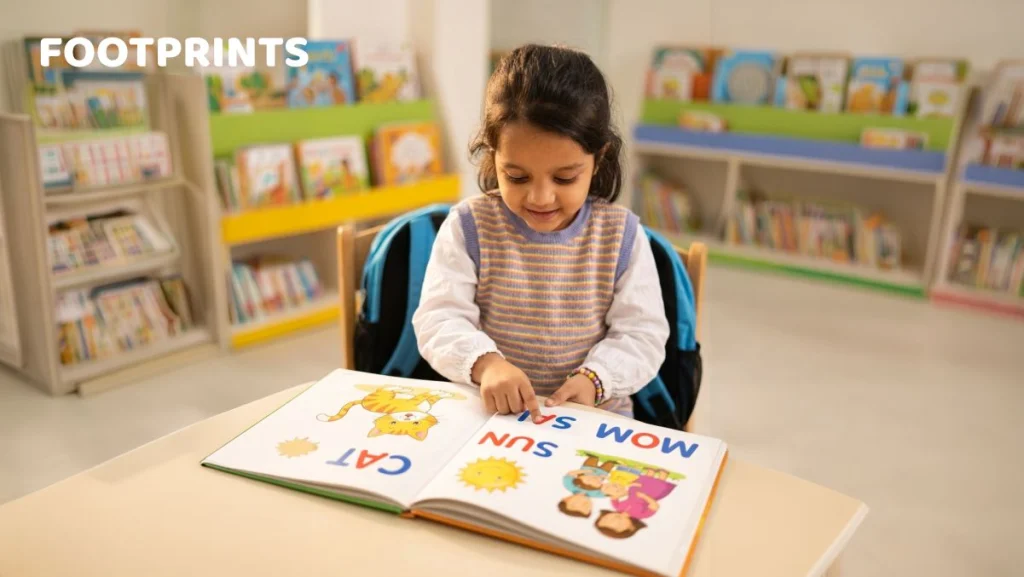
Three Letter Words for Children (Grouped by Word Family)
Three‑letter words in English are often called CVC words (consonant‑vowel‑consonant). Examples like c‑a‑t or d‑o‑g are the first real words children can sound out on their own. This is where reading truly begins, as kids connect letters, sounds, and meanings. Learning these words also introduces children to phonics sounds A to Z, helping them match each letter with its sound while blending them into complete words. Here are some common three letter words for kindergarten:
| Word Family | Examples |
| ‑at words | cat, bat, hat, mat |
| ‑an words | man, fan, pan, ran |
| ‑en words | pen, hen, ten, men |
| ‑in words | pin, tin, win, fin |
| ‑og words | dog, log, fog, jog |
| ‑un words | sun, run, fun, bun |
Parents can also make learning fun by turning word families into rhymes, flashcards, or drawing games.
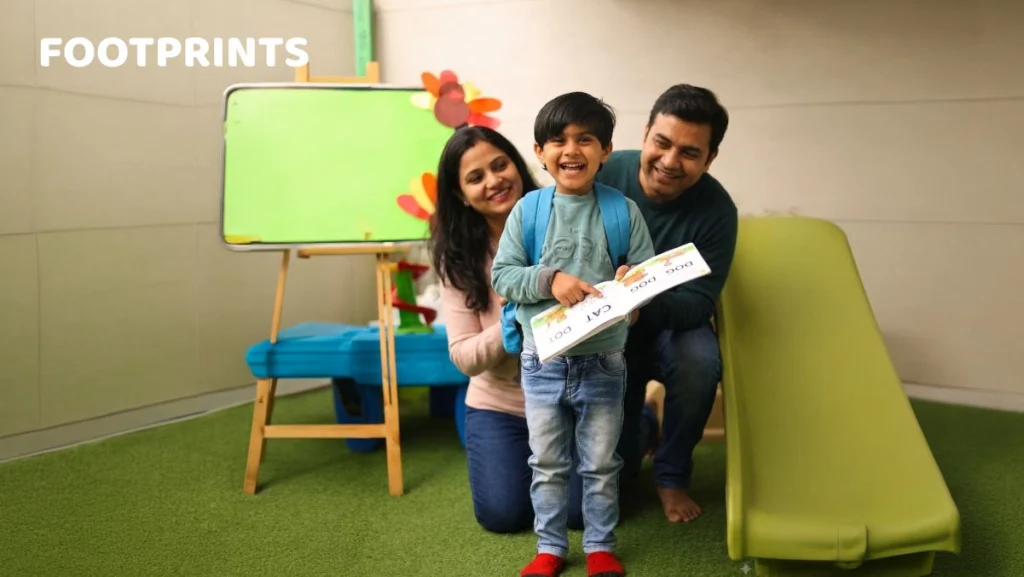
Four Letter Words to Grow Into (For UKG and Above)
Once children are confident with three‑letter CVC words and can blend phonic sounds smoothly, they are ready to move into simple four‑letter words. These words expand vocabulary and help children form longer sentences.
| Four Letter Words |
| ball, book, milk, hand |
| play, jump, clap, sing |
| door, room, lamp, bell |
| fish, bird, tree, leaf |
| cake, rice, corn, soup |
| star, moon, rain, wind |
| ship, boat, road, park |
5 Fun Ways to Practise These Words at Home
You can use these playful methods to turn word practice into everyday fun, helping children build confidence while enjoying the process of learning.
1. Word Hunt Around the House
Hide word cards around the room and let children “hunt” for them. Each time they find one, they read it aloud.
2. Magnetic Letters on the Fridge
Use magnetic alphabet letters to spell simple words like cat or ball. Children will have fun rearranging the letters to make words.
3. Word Bingo
Create bingo cards with two‑, three‑, and four‑letter words. Call out words, and children mark them off until someone shouts “Bingo!”
4. Flashcard Games
Make flashcards with words and pictures. Play quick rounds where children match the word to the picture or race to read the card first.
5. Label Household Objects
Stick labels on items like door, book, or lamp. Encourage children to read them whenever they use the object.
Alongside phonics, some common words are learned by sight rather than sounding out—see our full guide on Sight Words for LKG and UKG.
Frequently Asked Questions
1. What age should a child start reading two letter words?
Most children begin recognizing and reading two‑letter words around age 4, once they know the alphabet and basic phonics sounds. These short words are perfect for early wins that build confidence. The CDC’s developmental milestones show that language and early reading skills build gradually through the preschool years, so steady practice matters more than speed.
2. What are CVC words and why do they matter?
CVC words are three‑letter words made of a consonant‑vowel‑consonant pattern, like c‑a‑t or d‑o‑g. They matter because they are the first words children can sound out independently, helping them connect phonics sounds A to Z into meaningful reading.
3. How many words should an LKG child be able to read?
By the end of LKG, many children can read 20–30 simple two‑letter and three‑letter words. The exact number varies, but the goal is steady progress and confidence, not speed or memorization.
4. Are there English words without vowels?
Yes! Fun examples include by, my, gym, and try. In these words, the letter y acts as a vowel, showing children that English has playful exceptions.
To Sum Up
Learning English words at home can be simple and joyful when broken into steps:
- Begin with two‑letter words — these are quick wins that build confidence and spark excitement.
- Move into word families of three‑letter CVC words — patterns like cat, bat, hat help children connect phonics sounds.
- Practice through play — Word hunts, flashcards, and labeling objects make reading part of everyday fun.
Zero to Three explains that early language and literacy grow through everyday moments of talking, reading, and playing together, long before formal reading begins.
At Footprints Play School, we approach reading and early literacy through active learning and integrating language development into daily routines.

Purvesh Sharma is a TED speaker, IIT-Delhi alumnus, certified life coach, and Co-Founder of Footprints Childcare — India’s safest preschool and daycare chain operating multiple centres across 30+ cities. He co-founded Footprints after recognising a fundamental gap: working parents in India needed a childcare option that combined genuine safety, research-backed curriculum, and real-time parent connectivity.
A certified life coach with deep exposure to behavioural science and developmental psychology, Purvesh leads parenting workshops and engagement programmes across Footprints centres — directly engaging with tens of thousands of Indian parents on the challenges of raising young children in urban India. As a parent himself, he brings lived experience to every piece he writes on child behaviour, tantrums, discipline, habit formation, and school readiness.
His writing is grounded in both the science of early childhood development and the real, daily decisions Indian parents face.
 View Fees
  Call Us