

Chances are, as a parent, you have often been advised to start teaching English early to preschoolers. What is missing in this advice, though, is clarity. Nobody really explains what to teach first. For instance, should you begin with letters or focus on their sounds or perhaps jump straight into words?
The fact is that this order matters a lot. This post gives you the exact 3-step sequence when it comes to English learning for children, mapped to ages – sounds first, words next, sentences last. It is a simple roadmap that takes the guesswork out of early English learning.
The Right Order to Teach English (Letters, Sounds, Words, Sentences)
According to the Harvard Center on the Developing Child, the brain circuits for language are built most actively in the first years of life, which is why early exposure matters more than formal drilling.
While this exposure is important, what is equally important is to offer this exposure in the right sequence.
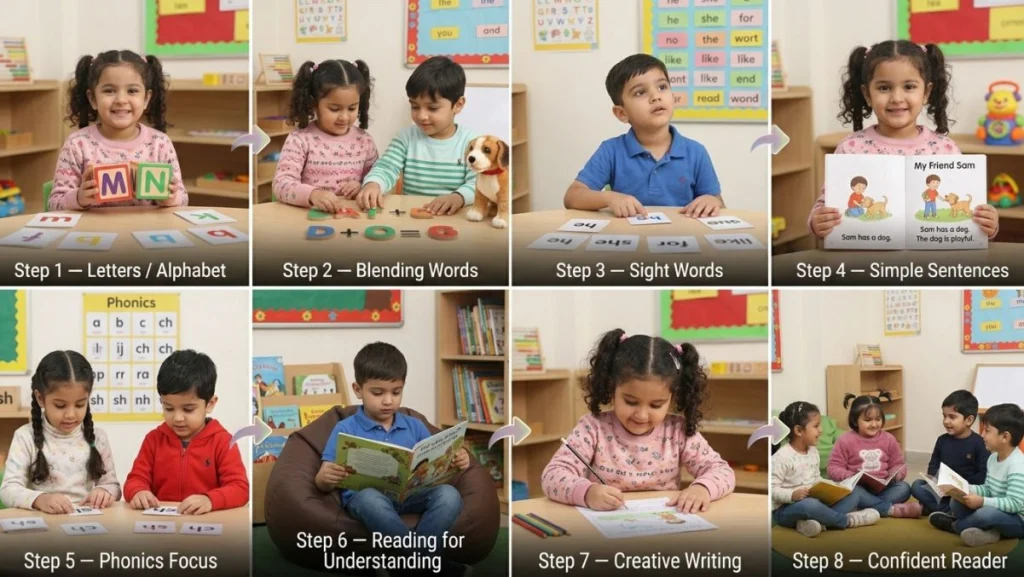
It is important to begin with sounds. Children can then decode these sounds and blend them naturally to form words. This, in turn, leads them to form sentences. Importantly, when you follow this order, children are known to pick up reading much faster and be more fluent in it.
Here is a simple age map:
- Ages 2–3: Start with ABC learning for children. Focus on letters and sounds, rhymes, as well as playful listening games.
- Ages 3–4: Move to simple words, especially high‑frequency ones like the, is, to, we. Here is a handy list of two and three letter words for children that can be a good starting point.
- Ages 4–5: Introduce sight words and short sentences, so children can begin to read simple storybooks with confidence.
What to Teach at Each Age
| Age | What to Focus On | What They Are Learning | What Success Looks Like |
| 2-3 Years | Letter sounds, not letter names | Listening and recognising sounds | Can point to a letter when you say its sound |
| 3-4 Years | Blending simple sounds into words | First reading of two and three letter words | Can sound out c-a-t and say “cat” |
| 4-5 Years (LKG) | Sight words plus word families | Reading common words instantly | Recognises 30-40 sight words without sounding out |
| 5-6 Years (UKG) | Simple sentences and short stories | Reading for meaning, not just decoding | Can read a simple sentence and say what it means |
Start With Sounds: Vowels, Consonants and Phonics
The English alphabet has 5 vowels (a, e, i, o, u). Children learn vowel sounds first because they are easier to hear and repeat. They also help children begin blending sounds into words. Consonants come next, giving structure to these vowel sounds.
Phonics helps children understand that different vowels and consonants represent particular sounds. Once children begin to recognise these sounds they also learn how to put them together to make words. This connection between letters, sounds and words is one of the building blocks of learning to read. For example, c‑a‑t becomes cat.
To teach phonics, it is helpful to start with playful listening games. You can then gradually introduce letter-sound cards and simple blending practice. It will help to keep the exercises short and fun. In fact just a few minutes of practice each day can go a long way.
If you want to deep dive into phonics sounds A to Z, here is a handy guide.
Building Vocabulary: From First Words to Word Families
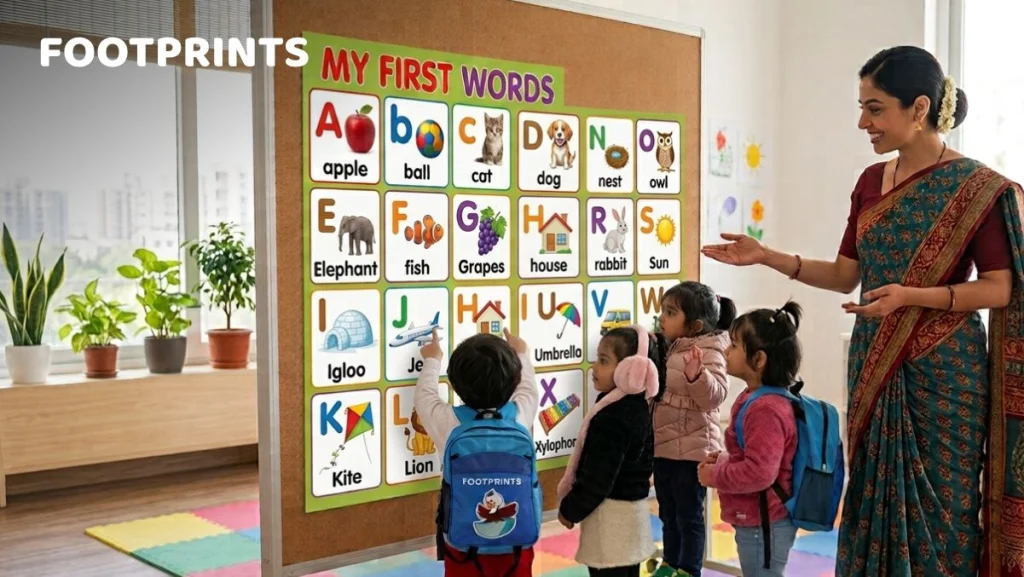
It is important to remember that a child’s vocabulary does not grow overnight . Instead it grows each day through play and conversation. In the preschool years, children pick up words naturally by listening to them and then repeating them. Parents can help in this growth with simple activities that can turn ordinary routines into learning moments.
To build vocabulary in young children, you could try these engaging practices:
Naming objects: Children love pointing to and naming things around them. Everyday words such as cup, ball, and dog are often among the first words they learn. Parents can turn everyday routines into simple naming games. You could point to objects at home, in the park and ask them to name what they see.
Opposites: Opposite words for children, such as big–small or hot–cold help expand the vocabulary while also teaching them contrasts. Parents can introduce these naturally through daily life. Think of a big spoon and a small spoon or hot food and cold water.
Rhymes: Words that sound alike, such as cat–hat or sun–fun, make language playful. Rhyming words for children also strengthen listening skills. Parents can add to the fun by saying a word and then asking the child to think of a word that rhymes with it.
Word families: Grouping words with the same ending helps children notice patterns in sounds. Parents can pick a simple ending such as ‘at’ and take turns calling out words such as hat, cat, bat and so on.
Everyday Vocabulary‑Building Habits
- Name during routines: Say words aloud while dressing or eating. Think of simple things like “ put your shirt on,” “milk is in the cup”.
- Read aloud daily: Reading aloud to children introduces new words in context, making them easier to remember.
- Word games in the car: Get the children to say rhyming words while all of you are driving together.
UNICEF notes that talking, reading, and singing with young children every day builds the foundation for language and lifelong learning.
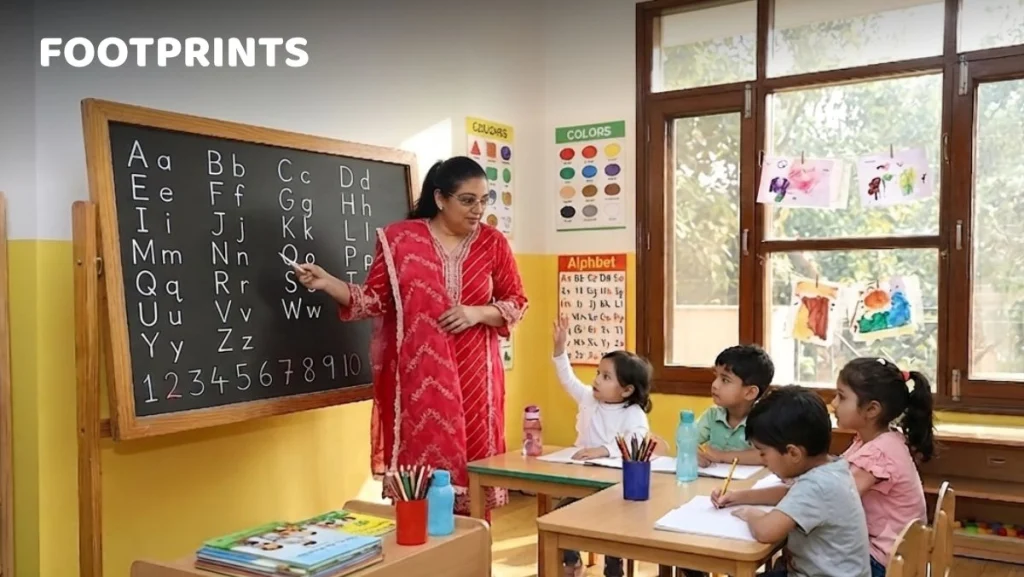
Sight Words: The Shortcut to Early Reading
Sight words are common words that children recognize on sight, without sounding them out. Since many of these words do not follow phonics rules (the, was, said, are), memorizing them helps with reading speed and fluency.
Simple practice method
Write 5 sight words on flashcards and flip them. Ask your child to “catch” the word by saying it as soon as they see it. The speed of the flip adds to the fun quotient while repetition makes them stick.
Here is a handy list of sight words for LKG and UKG along with step‑by‑step practice routines.
From Words to Sentences: Simple Sentences for Kindergarten
Children naturally progress from single words (“dog”) to 2–3 word phrases (“big dog”) and eventually to simple sentences (“The dog is big”). This step‑by‑step growth adds to their confidence and also improves their reading ability.
At‑home practices to build sentences include:
- Sentence completion games – Go ahead and say “The cat is…” and let your child complete the sentence with big or small.
- Describing pictures- Show the child a photo or drawing and ask, “Tell me what you see.”
- Tell‑me‑about‑your‑day – Encourage your child to share one or two sentences about school or playtime.
- Mix sight words with phonics words – Use flashcards that help the child build short sentences like I can go or We are here.
Pro tip – As children move from words to sentences, the goal is not perfection but confidence. Each small step, whether finishing a phrase or describing a picture, improves their ability to express themselves.
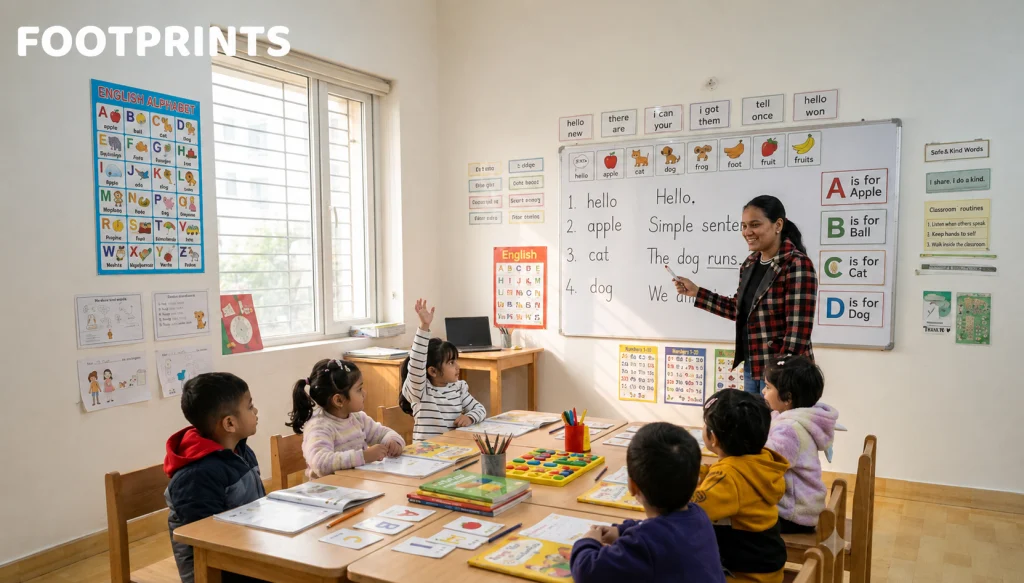
What Not to Do When Teaching English to a Young Child
Parents often want quick results when it comes to their children learning English. The early years, however, are about play and natural exposure as opposed to pressure or perfection. Avoiding a few common mistakes keeps the journey stress‑free and helps children build confidence step by step:
- Forcing writing too early: Tiny hands need time to develop. Rushing them to write the alphabet before they are ready can lead to frustration.
- Correcting every error: As parents you would want them to write beautifully. However, constant correction can prove to be detrimental. Remember that mistakes are a part of learning.
- Comparing with other children: Every child is unique and learns at their own pace. Comparisons do little else than add pressure.
- Drilling instead of playing: Preschool learning should feel like play. Endless drills make learning English feel like a chore and impacts their long term approach towards it.
- Expecting silent study at age 3: At this stage, learning is loud and active.
Avoiding these common pitfalls keeps English learning joyful and age‑appropriate.
Frequently Asked Questions
1. What age should a child start learning English?
Children can begin as early as age 2–3, through songs, rhymes, and listening games. At this stage, it is about exposure and fun as opposed to formal study.
2. Should I teach letters or sounds first?
Always start with sounds before letters. When children hear and play with sounds, they learn to read faster than if they only memorize spellings.
3. How many words should an LKG child know?
By the end of LKG, children usually recognize 30–40 sight words and a growing set of everyday vocabulary. This gives them a strong base for UKG.
4. Is it OK to mix Hindi and English while teaching?
Yes, mixing languages is natural and helps children connect meaning. Just keep English words consistent so they do not get lost in translation.
5. How long should daily English practice be for a preschooler?
Keep it short and sweet. 5–10 minutes daily is enough. Playful repetition works better than long sessions, which can tire young learners.
NAEYC’s early literacy guidance shows that young children learn language best through playful, everyday interaction rather than formal instruction.
To Sum Up
Learning English for preschoolers is not about rushing them into it or piling on worksheets. Instead, it is about following the right order, keeping practice sessions short and steady, and overall making learning feel like play. The three principles below keep children engaged and confident as they grow from sounds to words to sentences:
- Start with sounds before spellings — Children who hear and play with sounds first pick up reading faster than those who only memorize letters.
- Daily habits beat weekly drills — Five playful minutes every day can build stronger skills than long sessions once in a while.
- Play is the method — Songs, games, and stories make English learning joyful.
At Footprints Preschool, we build English and communication skills naturally through active, child-led play.

Mirza Usman Habib is a senior early education content specialist with over 8 years dedicated to researching, writing, and explaining early childhood education for Indian parents. At Footprints Childcare, he has authored over 100 articles spanning child development milestones, preschool admission processes, teaching methodology comparisons (HighScope vs Montessori vs Playway), infant daycare selection, and the science of early brain development.
Usman’s approach is research-first: each article synthesises findings from leading authorities in early childhood education — including the HighScope Foundation, UNICEF, and the American Academy of Pediatrics — and translates them into practical, accessible guidance for working parents across India’s 30+ major cities.
His writing covers preschool selection guides, child safety checklists, developmental milestone trackers, and parent preparation guides for school admission. All child development content is reviewed by Amita Bhardwaj, Chief Delivery Officer and HighScope-certified trainer at Footprints Childcare.
 View Fees
  Call Us