

If your child’s school diary comes with the mandate of “practice sight words at home,” it may leave you wondering what makes these words special.
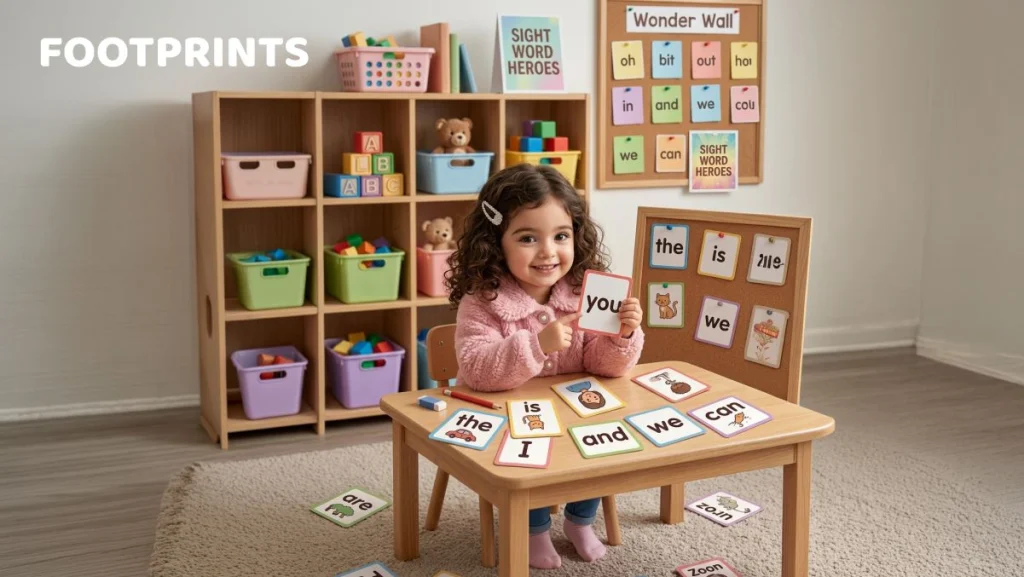
Simply put, sight words are common words that are remembered by sight and not by blending sounds. Sight words derive their name from the fact that children learn to recognise them by seeing them instantly. Words like the, was, and said are common examples of sight words. Practising sight words also supports early English learning for preschoolers by helping children recognise familiar words more confidently.
In this post, you will find two complete age‑wise lists (LKG and UKG) plus a simple practice method that takes just 5 minutes a day.
What Are Sight Words and Why Do Schools Insist on Them?
Sight words exist for two big reasons. First, they appear constantly in every text — words like the, is, was, and said show up on almost every page. Second, these words break phonics rules, and children cannot sound them out and therefore must learn to recognise them.
The payoff of knowing sight words is huge. A child who knows just 50 sight words can already read most of a simple storybook with confidence. NAEYC’s early literacy guidance notes that recognising familiar words quickly frees a young reader’s attention for understanding the story itself.
It is important to remember that sight words and phonics work together, not instead of each other. If phonics helps children decode new words, sight words give them fluency with the most common ones. For more on phonics, see our Phonics Sounds A to Z post.
Before getting to sight words, if you think two- and three-letter words need practice, you can find a handy list here.
Sight Words for LKG Students (The First 40)
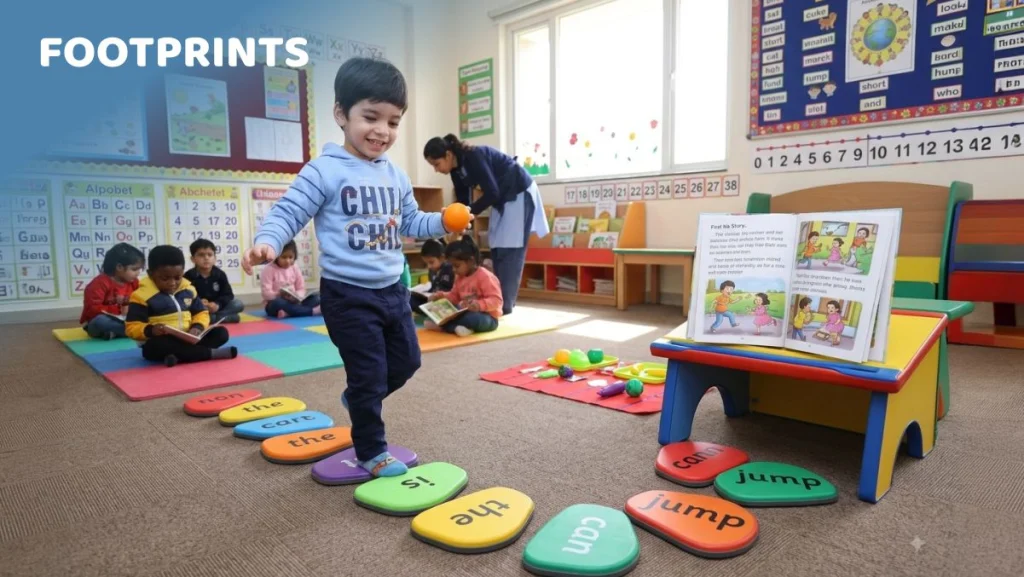
For LKG students, sight words are taught gradually. It is important that they master one set before moving to the next so they can build confidence step by step.
| Set 1 | Set 2 | Set 3 | Set 4 |
| a | he | go | up |
| I | she | no | look |
| the | to | see | come |
| is | we | can | down |
| it | me | and | here |
| in | my | you | not |
| on | at | am | big |
| at | be | do | little |
| an | so | of | one |
| by | all | as | two |
Sight Words for UKG Students (The Next 60)
Before starting these sets, it is prudent that children revise LKG sight words to ensure fluency. These UKG words add more variety while also including tricky, phonics‑breaking essentials.
| Set 1 | Set 2 | Set 3 | Set 4 | Set 5 | Set 6 |
| the | was | said | are | have | come |
| some | what | where | who | when | why |
| they | there | here | their | them | then |
| out | about | very | every | only | again |
| do | does | want | like | all | also |
| once | upon | always | could | should | would |
| because | before | after | were | been | into |
| over | under | around | any | many | more |
| go | to | no | so | one | two |
| three | four | five | six | seven | eight |
Sight Words to Simple Sentences
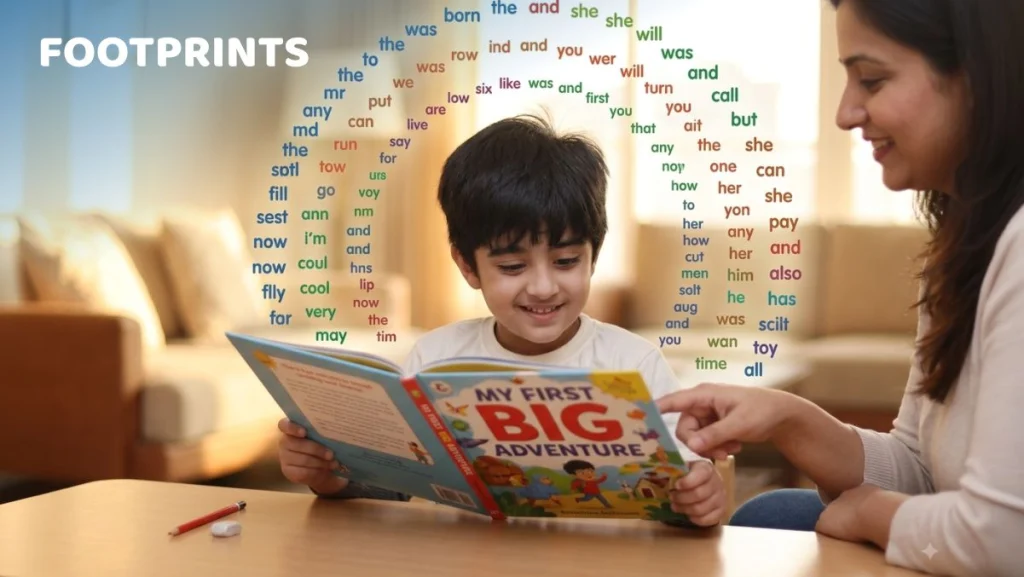
Once children know their sight words, the next step is combining them into short, meaningful sentences.
Here are some examples:
- I can see the cat.
- He is in the car.
- The dog was here.
- We go to the park.
- She said it is big.
- They are at home.
It is important to remember that daily practice is key. You could do it by way of storybook reading, pointing out sight words inside the text and letting your child read them aloud. Just 5 minutes a day can go a long way in building confidence and fluency.
5-Minute Daily Practice Methods That Actually Stick
1. Flashcard Flip Game
Write sight words on cards and flip them quickly. Ask your child to “catch” the word by saying it aloud. The speed makes the exercise fun.
2. Storybook Word Hunt
During bedtime reading, pause and let your child spot sight words like the or was inside the text. Children enjoy this exercise as it turns reading into a treasure hunt.
3. Sticky Wall Words
Put sticky notes with sight words on a wall or door. Each time your child passes it, they can read one aloud.
4. Word of the Day at Breakfast
Choose one sight word each morning. Write it on a card and use it in sentences at the breakfast table.
5. Spot‑It in the Street
Point out sight words on shop signs, billboards, or posters while walking outside. Real‑world spotting makes words feel useful.
These short and playful routines keep sight word practice light and consistent.
Frequently Asked Questions
1. How many sight words should an LKG child know?
By the end of LKG, children usually recognize about 40 sight words (like a, I, the, is, in, on). These are the foundation for UKG learning.
2. How many sight words should a UKG child know?
UKG students typically expand to 60 sight words, including phonics‑breaking essentials (was, said, are, have, come, some, what, where, who). This prepares them for simple storybooks.
3. What is the difference between sight words and phonics?
Phonics teaches children to decode new words by blending sounds. By contrast, sight words often don’t follow sound rules. Together, the two make reading possible.
4. My child keeps forgetting sight words — what should I do?
Use playful repetition — flashcards, sticky notes, or spotting words in storybooks. Short, daily practice helps words stick.
The CDC’s developmental milestones show wide normal variation in early language skills, so a child who needs more repetition with sight words is usually right on track
5. Should sight words be taught before or after phonics?
They work best side by side. Phonics builds decoding skills, while sight words give instant fluency.
To Sum Up
- Sight words unlock fluent reading. Once children recognize them instantly, reading becomes that much easier.
- Teach in small sets. It is best to go with 10 words at a time before moving forward.
- Consistency beats cramming. 5 minutes of playful practice each day works far better than doing it for an hour once a week.
With this steady approach, parents can turn sight word practice into a joyful routine that truly sticks.
Zero to Three emphasises that early literacy grows through warm, everyday reading moments together, and sight word practice fits naturally into that routine.
At Footprints Play School we use active learning that allows children to build stronger brain connections to remember high-frequency sight words.

Mirza Usman Habib is a senior early education content specialist with over 8 years dedicated to researching, writing, and explaining early childhood education for Indian parents. At Footprints Childcare, he has authored over 100 articles spanning child development milestones, preschool admission processes, teaching methodology comparisons (HighScope vs Montessori vs Playway), infant daycare selection, and the science of early brain development.
Usman’s approach is research-first: each article synthesises findings from leading authorities in early childhood education — including the HighScope Foundation, UNICEF, and the American Academy of Pediatrics — and translates them into practical, accessible guidance for working parents across India’s 30+ major cities.
His writing covers preschool selection guides, child safety checklists, developmental milestone trackers, and parent preparation guides for school admission. All child development content is reviewed by Amita Bhardwaj, Chief Delivery Officer and HighScope-certified trainer at Footprints Childcare.
 View Fees
  Call Us