

It is Tuesday night and your toddler has been on his tablet watching cartoons since dinner time. Come 9 pm and you begin the bedtime routine. An hour goes by without much success and you find the child to be as alert as ever.
If the above scenario sounds familiar, screen time in the evening is the first thing worth focusing your attention on. Research shows that the blue light emitted by screens suppresses your child’s natural sleep hormone, melatonin, by tricking the brain into thinking it is still daytime. Added to that is the fact that stimulating content keeps an already-tired brain switched on, contributing to toddler sleep problems.
This post explains age-wise sleep requirements for children, the impact of screen time on child development, and a practical 5-step screen-free wind-down routine.
How Many Hours of Sleep Does Your Child Actually Need?
How many hours should a child sleep? That is the question on the minds of most parents. To begin with, it is important to understand that sleep is not optional downtime for toddlers. For it is when the brain consolidates learning and processes emotions while the body repairs itself.
Most toddlers need significantly more sleep than parents expect– here is what research recommends by age.
Recommended Sleep Hours for Children (Age-Wise)
| Age | Recommended Sleep | Including Naps? | Bedtime to Aim For |
| 12–18 months | 12–14 hours/day | Yes — 1 nap of 1–2 hrs | 7:00–8:00 PM |
| 2 years | 11–14 hours/day | Yes — 1 nap still common | 7:00–8:00 PM |
| 3 years | 10–13 hours/day | Nap optional — many drop it | 7:30–8:30 PM |
| 4–5 years | 10–13 hours/day | Usually no nap | 7:30–9:00 PM |
If the child is consistently getting less sleep than recommended, the effects will show in their mood, attention, appetite and behaviour. The first logical step is identifying what cannibalising sleep time is. For many families, evening screen time may be the answer.
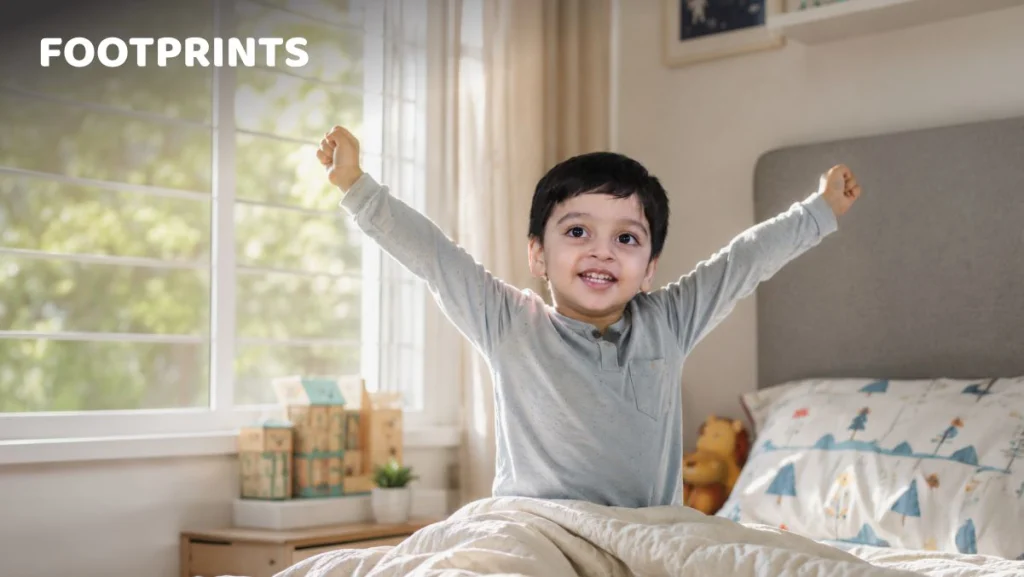
What Screen Time Actually Does to Your Child’s Sleep
When it comes to screen time and sleep, there is a direct correlation. Here are several ways in which screen time affects your child’s sleep
1. The blue light and melatonin problem
- Screens emit blue-wavelength light, which directly suppresses melatonin, the hormone that tells the brain it is time to sleep.
- Even 20–30 minutes of screen use in the hour before bedtime can delay melatonin release by 30–45 minutes.
- The effect is stronger in young children than adults because their pupils are larger and let in more light.
2. Overstimulation at the wrong time
- The brain needs a gradual wind-down of 45–60 minutes to transition from active to sleep state. Stimulating screen content works directly against this principle.
- Fast-paced videos, bright colours, and rapid scene changes activate the brain’s alert and reward systems.
- Even ‘calm’ educational content can delay sleep if watched right before bedtime, because the brain is still processing and retaining what it just saw
3. The autoplay and one-more-video trap
- The autoplay feature adds to the viewing duration as it removes the natural stopping point.
- 10 minutes of screen time before bed often becomes 45 minutes simply because the content is designed to keep viewers watching
- Each new video resets the excitement level, making the brain even harder to wind down
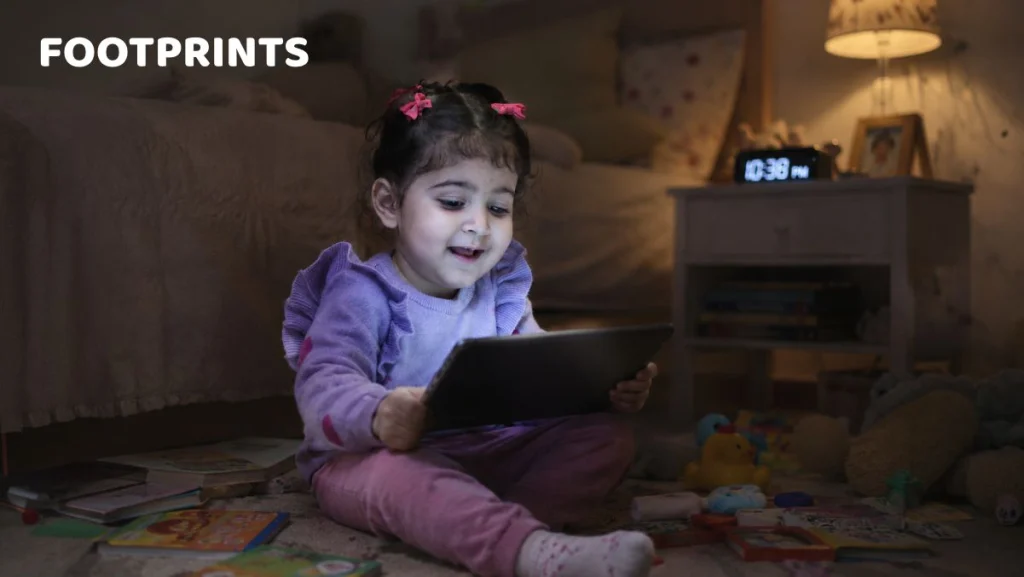
Signs That Evening Screen Time Is Disrupting Your Child’s Sleep
If you are contending with the baby not sleeping at night or that your 2 year old is waking up at night crying, here are some signs to watch out for. These signs will indicate to you if screen time is coming in the way of your child’s sleep.
- The child takes more than 30–40 minutes to fall asleep after being put to bed
- Wakes multiple times through the night without an obvious reason such as illness, or hunger
- Wakes up irritable in the morning despite what looks like a full night of sleep
- Needs a screen to fall asleep and does not settle without one playing in the background
- Bedtime battles have become more intense or frequent than before
- Daytime behaviour has changed. You witness more tantrums, clinginess, or inability to focus
- Is waking earlier than usual in the morning
If you notice any 3 or more of the above signs consistently, adjusting evening screen time is the most practical first step to take, before you turn to sleep training, supplements or any other interventions.
A 5-Step Screen-Free Bedtime Routine That Actually Works
If how to make baby sleep at night has been your go-to question, here is a 5-step bed time routine that will give you results:
Step 1 – Screens off 60 minutes before target bedtime
- The single most effective change families can make is to ensure that screens are off 1 hour before bedtime.
- As opposed to getting into a power struggle, use a visual timer so the toddler can see the time winding down.
Step 2 – Dim the lights in the home
- Bright overhead lights keep melatonin suppressed almost as effectively as screens
- Dimming the lights 45 minutes before bed signals to the brain that sleep time is approaching.
Step 3 – Warm bath or wash
- A warm bath followed by the cool air of the bedroom triggers a drop in body temperature. This in turn, is a physical signal for the onset of sleep
- Even a 5-minute warm wash followed by getting into pyjamas is enough
Step 4 – Read together (1 to 2 books)
- Reading aloud is the single best screen replacement at bedtime. Importantly, it is a ritual that is calm, language-rich, and shared
- You need not look for educational content. Any book that the child enjoys works
- The predefined reading slot gives the toddler a positive activity to associate with bedtime, reducing resistance to sleep.
Step 5 – Same sequence every night
- Ensure that you follow a predefined ritual. Think: bath → pyjamas → dim lights → books → bed
- The brain learns to associate this sequence with sleep. After 7–10 consistent nights, the routine itself begins to trigger drowsiness
- Pro tip: Consistency across caregivers matters. The routine must work the same way whether it is mum, dad, or grandparents putting the child to bed.

What If Your Toddler Can’t Sleep Without a Screen?
If so far you have been using the screen as a sleeping aid, you can work towards changing this habit gradually.
A gradual reduction over 1-2 weeks typically works well for the whole family. In order to aid the transition, you can replace the screen with an audio alternative first. Think a calm audiobook, a favourite nursery rhyme playlist or even white noise.
That said, you need to be prepared for 5-7 nights of increased resistance. The important bit is to stay consistent. If you give in to the resistance and re-introduce the screen on day 4, you would have only taught your toddler that adequate resistance brings the screen back.
Frequently Asked Questions
1. How much screen time before bed is OK for a 2-year-old?
For a 2‑year‑old, the safest guideline is no screen time an hour before bed. Even small amounts can interfere with sleep quality.
2. Why is my toddler waking up at 2 am and crying?
Night waking and crying at 2 am is very common in toddlers, and it usually reflects a mix of developmental, emotional, and physical factors. A common cause however, may be that evening screen time could be affecting your child’s sleep.
3. What time should a 2–3-year-old go to bed?
At that age, the child should ideally go to bed between 7-8 pm and get 11-14 hours of sleep including afternoon naps.
4. Does a daytime nap affect night sleep for toddlers?
While daytime naps are essential for toddlers, the timing and length of the nap can affect how well they sleep at night.
5. Can I use the TV as background noise while my child falls asleep?
It is not recommended to use TV as background noise. This is on account of many reasons, primary among them being the fact that the not-so-calming sounds keep the brain alert. Besides, if your child learns to rely on TV to fall asleep, they may wake at night and cry until the TV is turned back on.
6. Is screen time at bedtime the only cause of toddler sleep problems?
While screen time at bedtime is a major disruptor of toddler sleep and screen time and child development are closely linked, it is only one piece of the puzzle. Sleep problems in toddlers often arise from a mix of developmental, emotional, and environmental factors.
7. How do I know if my child is addicted to screens?
Signs of screen addiction in children include sleep disruption, loss of interest in play, delayed speech or social skills, shortened attention spans, and more.
To Sum Up
Screen time in the evening makes it far harder for toddlers to fall asleep and to stay asleep. The fix is to ensure that screens are switched off 60 minutes before bedtime and that a consistent wind-down routine is followed. A good bedtime routine pays back every morning as the child wakes up calmer, more focused and emotionally regulated.
For more such informative content stay tuned to this space. At Footprints Play School, we are committed to the child’s holistic development.

Mirza Usman Habib is a senior early education content specialist with over 8 years dedicated to researching, writing, and explaining early childhood education for Indian parents. At Footprints Childcare, he has authored over 100 articles spanning child development milestones, preschool admission processes, teaching methodology comparisons (HighScope vs Montessori vs Playway), infant daycare selection, and the science of early brain development.
Usman’s approach is research-first: each article synthesises findings from leading authorities in early childhood education — including the HighScope Foundation, UNICEF, and the American Academy of Pediatrics — and translates them into practical, accessible guidance for working parents across India’s 30+ major cities.
His writing covers preschool selection guides, child safety checklists, developmental milestone trackers, and parent preparation guides for school admission. All child development content is reviewed by Amita Bhardwaj, Chief Delivery Officer and HighScope-certified trainer at Footprints Childcare.
 View Fees
  Call Us