

Picture a 3‑year‑old being asked to write A, B, and C in a ruled notebook. Their tiny fist clenches the pencil with all its strength. As tentative letters form across the page, frustration rises, both for the child struggling to control the pencil and the parent wishing for progress.
Here is the truth behind this familiar scene. The child’s hand simply isn’t ready for writing yet. Forcing writing before the muscles are developed often creates a grip that becomes very hard to fix later. When children are getting ready for preschool, what matters most is not early letter formation but building the right foundations.
This post focuses on what really matters before writing begins – which grip to expect at which age so parents know what is developmentally normal, how to build hand strength and what pre-writing practice should actually look like so children enjoy the journey instead of resisting it.
Why Writing Starts in the Shoulder, Not the Fingers
It is important to know that writing control does not begin at the fingertips. It develops from the shoulder outward. First the shoulder stabilizes, then the elbow, then the wrist, and only after that can the fingers manage fine movements. A child simply cannot control a pencil tip until the larger joints are steady, which is why rushing finger work too early leads to frustration and poor grip habits.
Practically, this means big arm movements build writing readiness far more than tracing worksheets do. Painting on a wall, drawing wide shapes in sand, or throwing balls, all strengthen the shoulder and wrist and lay the foundation for later pencil control.
The CDC’s developmental milestones show that skills like copying shapes and drawing recognisable figures appear gradually across the preschool years, well before formal writing is expected.
The Tripod Grip and What to Expect at Each Age
The tripod grip is a hand posture where the thumb and first two fingers gently hold the pencil, while the ring and little finger are tucked in for support. In this grip, the fingers and not the wrist or arm, do the fine movements.
That said, it is important to remember that the tripod grip is the destination, not the starting point. A 3‑year‑old with a fist grip is exactly where they should be. Pencil control develops step by step, and each stage is part of the journey.
Pencil Grip by Age
| Age | Grip You Should Expect | What It Looks Like |
| 1–2 years | Fist grip | Whole hand wrapped around the crayon, arm does the moving |
| 2–3 years | Palm grip | Crayon across the palm, wrist starts to move |
| 3–4 years | Four or five finger grip | Fingers involved but not yet settled, still developing |
| 4–6 years | Tripod grip | Thumb and two fingers, fingers do the moving — the mature grip |
If a child is 6 or older and is using a full fist grip with no finger movement, it is worth bringing it to the teacher’s notice. It may be a sign that the child needs extra support.
Fine Motor Skills Activities That Build a Strong Hand
Before a child can master the tripod grip, their hands and fingers need strength and control. Below are some handy fine motor skills activities that can prepare little hands for writing.
1. Clay or Atta Dough Play
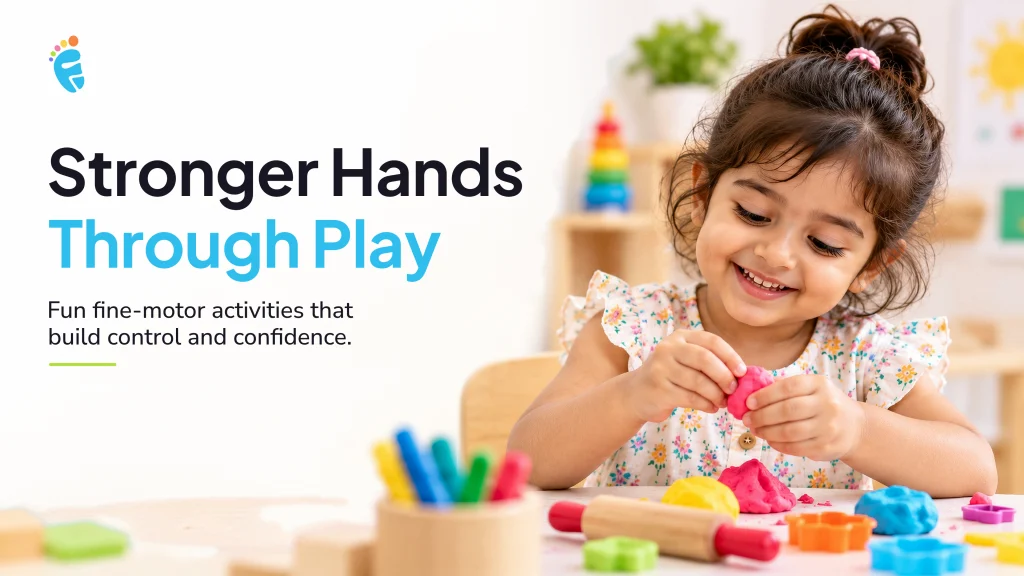
Give your child a ball of clay or atta dough to squeeze, roll and shape. This activity strengthens the whole hand, especially the palm and fingers, while improving coordination. The repeated squeezing and rolling mimic the pressure and control needed later for holding a pencil.
2. Paper Tearing Collage
Offer old magazines, newspapers or colored paper. Ask the child to tear pieces into different sizes and glue them onto a sheet to make patterns or pictures. Tearing requires finger isolation and strength, especially in the thumb and forefinger.
Art is the most enjoyable way to do all of this- children stay engaged while their fingers get stronger.
3. Threading Beads or Pasta
Provide chunky beads or pasta with a shoelace or string. Let the child thread the beads into a necklace. It will improve the child’s grip and hand-eye coordination. The child feeling proud of their handiwork is an added perk.
4. Tongs or Chimta Challenge
Set up a bowl of small toys or cotton balls and let children transfer them into an empty bowl using tongs. Alternatively, you can also place some rajma beans in a bowl and ask children to transfer them individually. Not only will the activity enthral the child, but it will also build grip strength and precision.
5. Spray Bottle Fun
Fill a spray bottle with water and let children have oodles of fun spraying water on plants. The activity strengthens finger muscles and builds endurance.
6. Clothes Pegs
Ask children to clip clothes pegs onto clothes set to dry. The child will be super happy participating in household chores while also strengthening finger pressure and control.
7. Buttoning practice
Keep an old shirt or jacket with buttons in your child’s play area. Encourage them to dress a doll by buttoning up the shirt. The activity strengthens finger isolation, coordination, and pressure control.
8. Opening and Closing Containers
Give the child a jar or a plastic container to twist and open. It will build wrist strength and problem-solving. Do make sure that there are no sharp edges that can hurt the child, though.
NAEYC highlights hands-on creative work as one of the most effective ways young children build the small hand muscles and control that writing later depends on.
Pre-Writing Activities: The Shapes That Come Before Letters
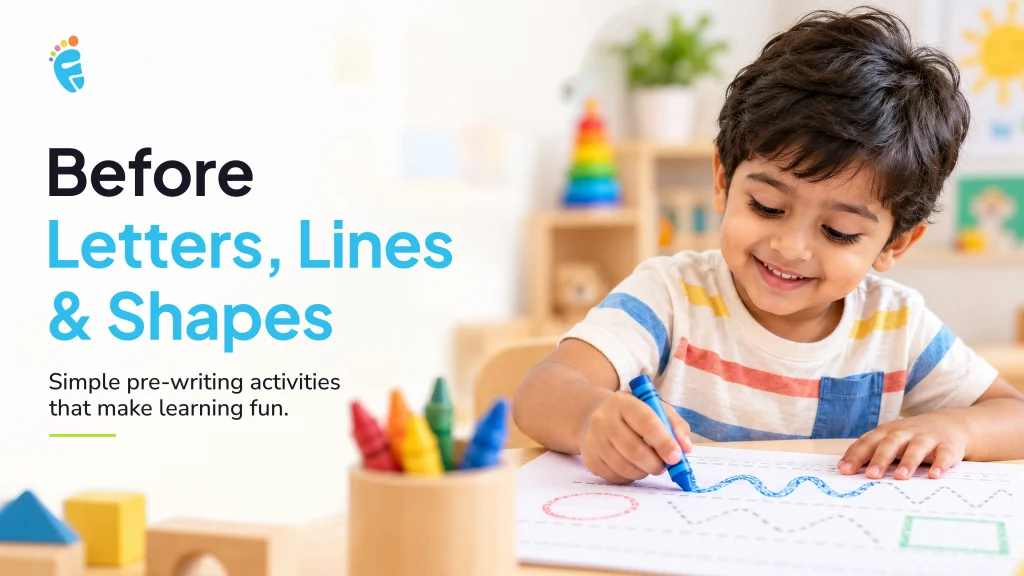
Before children can write letters they need to first master a sequence of shapes – vertical line, horizontal line, circle, cross, square, diagonal lines, and triangle, roughly in this order between ages 2 and 5.
This is important since every letter is built from these strokes. For example, a child who can draw a circle and a straight line already has the building blocks for letters like a, b, d, o, p.
The good news is that children don’t need worksheets to practise these shapes. Playful activities can work best:
- Let them trace lines and circles with their finger in a tray of aata or sand.
- They can also paint big shapes on chart paper. Wide arm movements build shoulder and wrist control.
- Encourage them to draw crosses, squares, and circles with chalk on the floor.
- Tracing shapes in the air can also be a lot of fun. Take turns to draw shapes such as a triangle in the sky.
When to Actually Start Letters and Writing
Letter recognition can start early through sounds and playful exposure. For instance, children love spotting the “A” in their name or singing the alphabet song. But actual pencil‑and‑paper letter formation usually suits most children around ages 4 to 5, once their hand muscles and grips are ready.
If your school has already sent writing homework for a 3‑year‑old, keep writing sessions very short. It will help to use a thick triangular crayon instead of a thin pencil and focus on the grip over the output.
The most natural way to teach writing is to let it grow out of play. When children see writing as an extension of the fun they already enjoy, it feels less like a chore and more like a skill they are proud to show off.
Once writing begins and you need help to practice two and three letter words for children, here is help.
Common Grip Mistakes and Easy Fixes
Even when children are ready to write, small grip errors can creep in. Here are some of the most common errors as well as easy ways to fix them:
- Thumb wrapped over fingers – It is common for children to keep the thumb wrapped over the fingers, blocking finger movement. The problem can be solved by tucking a small ball of paper or tissue under the last two fingers. This keeps the thumb in place and frees the fingers to move.
- Gripping too tightly – Every so often children tend to hold the pencil with too much pressure, leading to fatigue. The simple fix to this problem is to offer short, thick crayons or triangular pencils. Their shape encourages a relaxed grip and prevents over‑squeezing.
- Holding the pencil too close to the tip – Oftentimes, children end up using their fingers in a manner that crowds the pencil tip, limiting visibility and control. Using short golf-style pencils can be of help as with less length children naturally hold further up.
- Pencil resting incorrectly in the web of the hand – Sometimes the pencil sits too high or too low in the space between thumb and index finger. In such cases you need to gently guide the pencil to rest in the ‘V’ of the hand, angled toward the shoulder for the correct pencil grip.
Frequently Asked Questions
1. At what age should a child hold a pencil correctly?
Most children develop the mature tripod grip between ages 4 and 6. Earlier grips, like the fist grip, are normal stages on the way there.
2. Is it bad if my 4-year-old holds the pencil in a fist?
Not at all. At 4, many children are still transitioning from whole‑hand grips. With play and fine motor activities, the grip will naturally refine.
3. What is the tripod grip?
It is the mature pencil hold where the thumb and first two fingers gently hold the pencil, while the ring and little finger tuck in for support. The fingers and not the arm do the fine movements.
4. Should my 3-year-old be writing letters?
Recognition of letters can start early through sounds and play, but pencil‑and‑paper writing usually suits children closer to 4 or 5. At 3, focus on shapes, grip and fun pre‑writing activities instead.
5. How do I fix my child’s pencil grip without making it a fight?
Keep corrections playful. Use short crayons or golf‑style pencils, tuck a tissue under the last two fingers. Ensure you celebrate their effort.
6. Does left-handedness affect pencil grip?
No. Left‑handed children develop the same tripod grip as right‑handed ones. The only adjustment you may need to make is to angle the paper slightly to the left. Never discourage left‑handedness as it is simply a natural preference.
To Sum Up
The journey to writing begins with strong hands. Building muscle and control through play lays the foundation long before children are ready to form words.
The tripod grip usually arrives naturally between ages 4 and 6, and earlier grips are simply stepping stones along the way.
Most importantly, playful activities like clay, tearing, threading, and painting prepare children far better than worksheets ever can, turning writing into a joyful skill rather than a forced task. Zero to Three points out that everyday play with hands, from squeezing dough to picking up small objects, builds exactly the control young children need for later writing.
Stay tuned to this space as we bring to you more such informative content. At Footprints Preschool we are committed to the child’s holistic growth and wellbeing.

Amita Bhardwaj is one of India’s few certified HighScope curriculum trainers, trained and certified by the US-based HighScope Educational Research Foundation — the same framework underpinning over 50,000 preschools across 20+ countries. As Chief Delivery Officer at Footprints Childcare, she has spent the last decade architecting the curriculum and learning outcomes across 230+ centres serving 60,000+ children across India.
With over 30 years in early childhood education, Amita has worked across infant care, toddler development, preschool pedagogy, and educator training. She is also a certified course leader at Landmark Education, the world’s largest personal development organisation, which informs her approach to child-centred learning and growth.
Amita writes on child development milestones, early brain development, age-appropriate activities, infant safety, and curriculum best practices. All parenting content published under the Footprints Childcare blog is reviewed and approved by her before publication.
 View Fees
 Call Us