

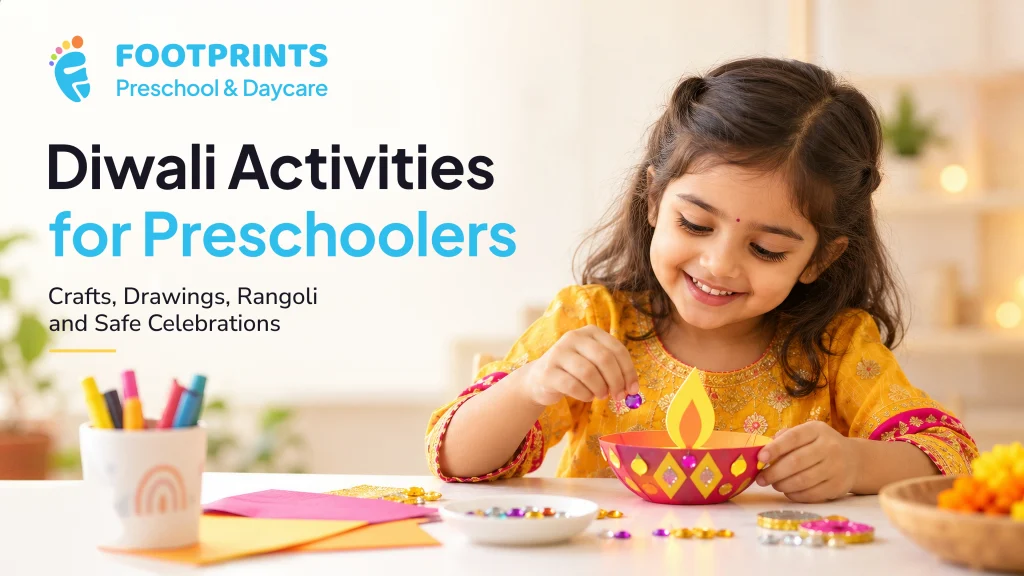
Pre-Diwali week in an Indian household is one of the busiest. There is cleaning to be done, lights to be put up, gifts to be distributed and a lot more. If you have a young child at home, odds are that they are keen to help with just about everything.
In this blog post you will read about interesting Diwali activities for preschoolers- crafts that the child can work on, Diwali drawings that they can put together, rangoli a child can actually make and more. Read on also for handy tips on how to keep the celebration safe for little ones.
Let us embark on a sparkling journey!
The Story of Diwali, Told Simply for Young Children
Before embarking on our journey of celebrating Diwali with preschoolers, let us begin with the story of Diwali that they will be fascinated with.
Diwali derives its name from the Sanskrit word ‘Deepavali,’ which means ‘rows of lighted lamps.’ Legend has it that on this day Lord Rama returned to Ayodhya from a 14-year exile in the forest after defeating the demon king Ravana. The people of Ayodhya lit their homes with oil lamps and with lamps and celebration. Even today, we light lamps to welcome people home and to signify the victory of light over darkness and good over evil. While Diwali may be celebrated by families differently across India but the central message remains the same.
This story can be beautifully narrated to preschoolers emphasizing the themes of goodness and truth.
Diwali Drawing Ideas for Children
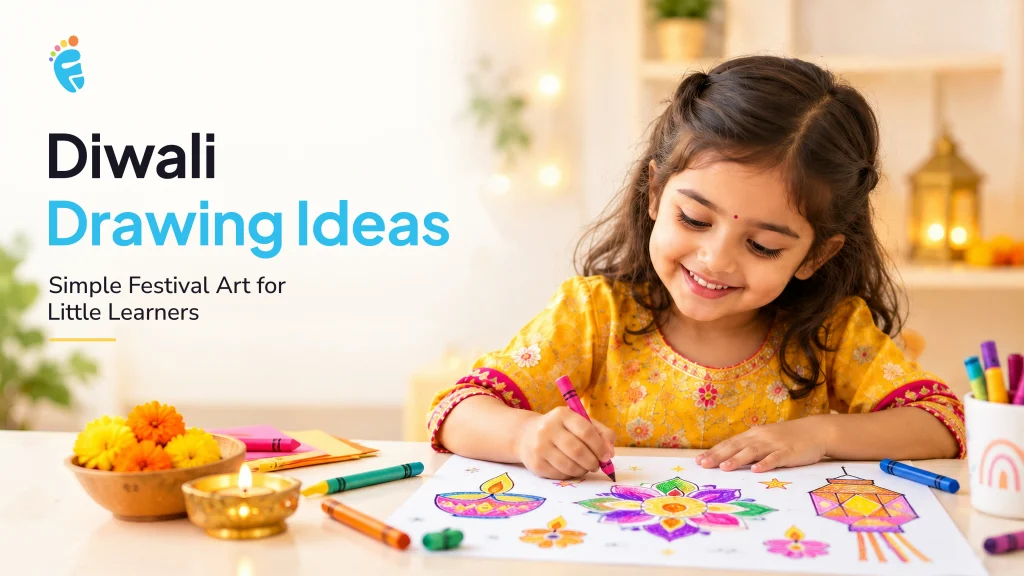
Diwali drawing is one of the simplest ways for preschoolers to join in the festive spirit. Let us get started on ways that children can create their own festive symbols:
1. Single Diya with Flame
Guide the child to start with an oval for the diya base. Next, let them add a teardrop shape for the flame. Color it orange and yellow.
2. Row of Diyas
Help the child draw a straight line. Next let them add small ovals along it for diyas, each with a teardrop flame. Children can color them in different shades.
3. Rangoli Pattern
Begin by drawing a big circle. Add petals around it like a flower. Let them have fun filling each section with dots or bright colors.
4. Decorated House with Lights
Let the child sketch a simple square for the house and a triangle for the roof. Next, let them add small dots or lines along the edges to show lights.
5. Lakshmi Footprints
Help the child draw two small oval shapes for the feet of the Goddess and add dots for toes. Place the footprints leading into a doorway.
6. Lantern
Draw a rectangle for the lantern body and a triangle on top. Now let them add lines for tassels below. Color it in bright reds and yellows.
7. Fireworks on Dark Paper
This idea will have children most excited. Use black paper. On it let the child draw bursts of lines and dots with white chalk or bright crayons. Next, add circles and stars for sparkle. The entire room will be lit up by the little one’s enthusiasm about his handiwork.
Pro tip- Remember that in all of this the idea isn’t to look for perfection. A three-year-old’s diya will be an oval with a scribble of flame, and that is fine.
Easy Rangoli for Children
Rangoli is a traditional art form that makes use of powder, rice, flowers and more to create beautiful patterns. It is believed to bring good luck and prosperity.
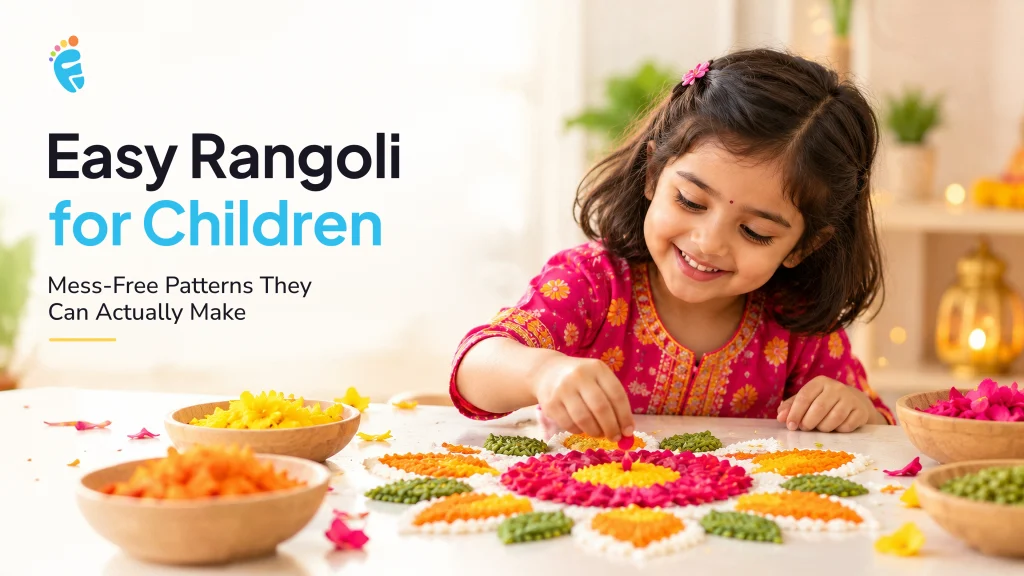
Easy rangoli for children means starting with circles, dots and other familiar shapes. NAEYC highlights creative art as one of the richest ways young children build fine motor skills and express ideas, and festival art adds cultural meaning to that practice. Here are some handy Rangoli ideas:
1. Flower Petal Rangoli
Help the child mark a circle on the floor or cardboard. Next, invite him or her to place petals around it like a flower. Add dots in the center. This Diwali rangoli that is made without any powder is the perfect mess-free version.
2. Colored Rice or Dal Rangoli
Colour rice or dal with food coloring. Now help the child create a circle outline, then fill petals or other simple shapes to create a beautiful work of art.
3. Handprint Rangoli
This one is likely to become the child’s favourite. Let them dip their palms in safe paint and press around a circle as if to form petals. Add dots in between.
4. Stencil Rangoli
Cut a simple paper stencil in the form of a flower or star. Now place it on the floor and let the child sprinkle chalk powder or colored sand over it.
5. Chalk Rangoli on the Floor
Help the child draw circles and petals with colored chalk directly on the ground. Add dots and lines for detail.
For more creative festival ideas, see our guide on art and craft for preschoolers.
Diya Decoration Ideas Children Can Manage
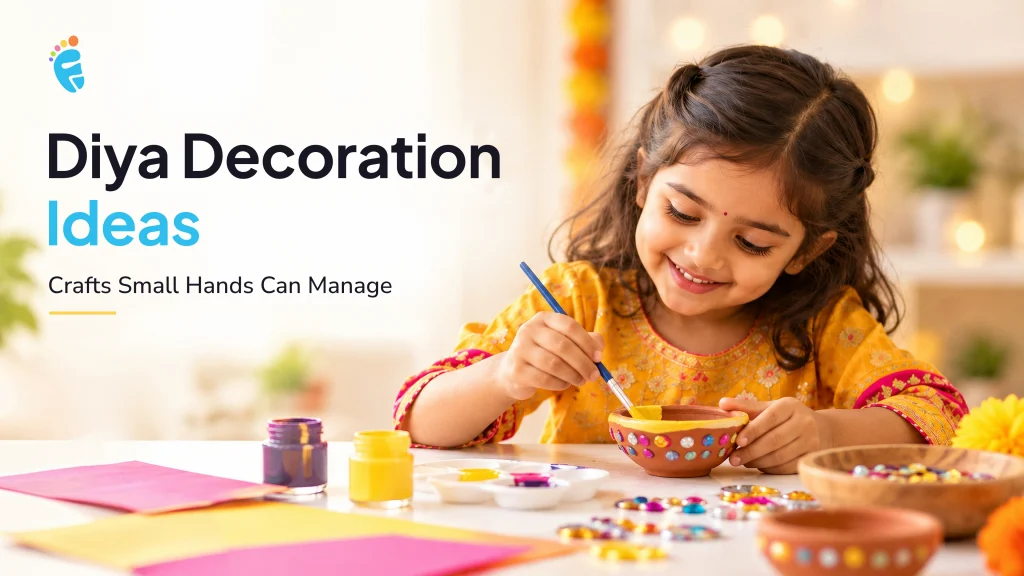
Clay diyas are perfect for preschoolers to decorate. All you need by way of setting up is some diyas that cost very little, a table that you can cover with newspaper, some colours and other basic materials.
1. Poster Paint with a Thick Brush
Give the child a plain diya and a thick brush and some bright poster paints for them to make bold, cheerful designs.
2. Coloured Paper Dots or Sequins
Help them stick paper dots or sequins onto the diya with glue. Children can make simple patterns without needing fine motor precision.
3. Coloured Thread Wrapping
Wrap colored wool or thread around the diya base. Help the child secure it with a dab of glue.
4. Cotton Bud Dot Patterns
Dip cotton buds in paint and let the child have fun pressing dots around the diya rim. It is an easy activity for small hands.
5. Glitter Glue Lines
Help the child squeeze glitter glue in wavy or zigzag lines across the diya. Now let it dry and create diyas that are all shiny and festive.
6. Mirror or Bindi Stickers
Get the child small mirror pieces or bindi stickers for sparkle. Children can place them randomly or in rows on the diya.
Diwali Greeting Cards and Gifts Children Can Make
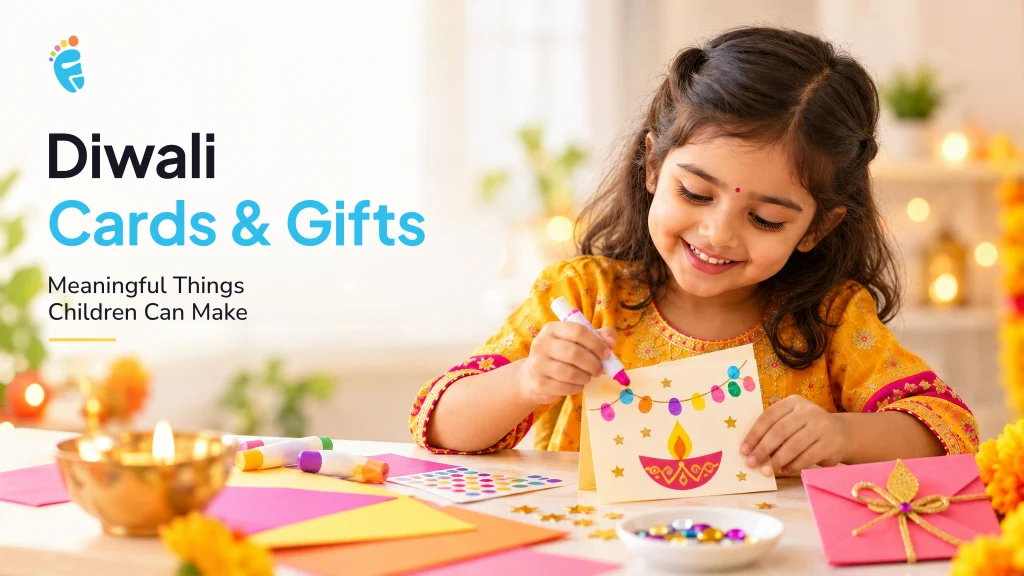
Making cards and small gifts is one of the easiest ways for preschoolers to join in the Diwali spirit. With paper, paint, and everyday materials, children can create something personal and meaningful.
1. Fold‑Out Diya Card
Simply fold a sheet of paper and let the child draw a diya on the front. Inside, add a simple colored paper cut‑out of a flame with “ Happy Diwali” written.
2. Handprint Card
Let the child dip their hand in safe paint and press onto the card. Next, help them add dots or lines to turn the handprint into a rangoli or diya design. Children can also add their name or a short wish.
3. Thumbprint Fairy‑Light Card
This is likely to be among the child’s favorites. Get them to press thumbprints in bright colors along a drawn line to make it look like fairy lights. Add glitter glue for sparkle. A preschooler can also write a short line to say “Lights make Diwali happy.”
4. Own Drawing Card
Give the child a blank card and let the child’s imagination take free rein. Let the child draw anything – a diya, fireworks, a house with lights, and more.
5. Decorated Envelope for Shagun
Let the child use stickers, sequins, or colored dots to decorate a plain envelope. Children can also add a small heart or star drawing inside.
6. Painted Photo Frame for Grandparents
Take a simple cardboard frame. Let children paint it in bright colors and add stickers. A preschooler can also add “I Love You” to be written on the back.
Giving matters as much as making. Encourage children to give their Diwali greeting cards not only to family but also to the building’s security guard, a helper, or a neighbour. It teaches them that Diwali is about sharing joy and kindness.
Keeping Diwali Safe and Calm for Young Children
When you are celebrating Diwali with a preschooler, it calls from some simple Diwali safety tips.
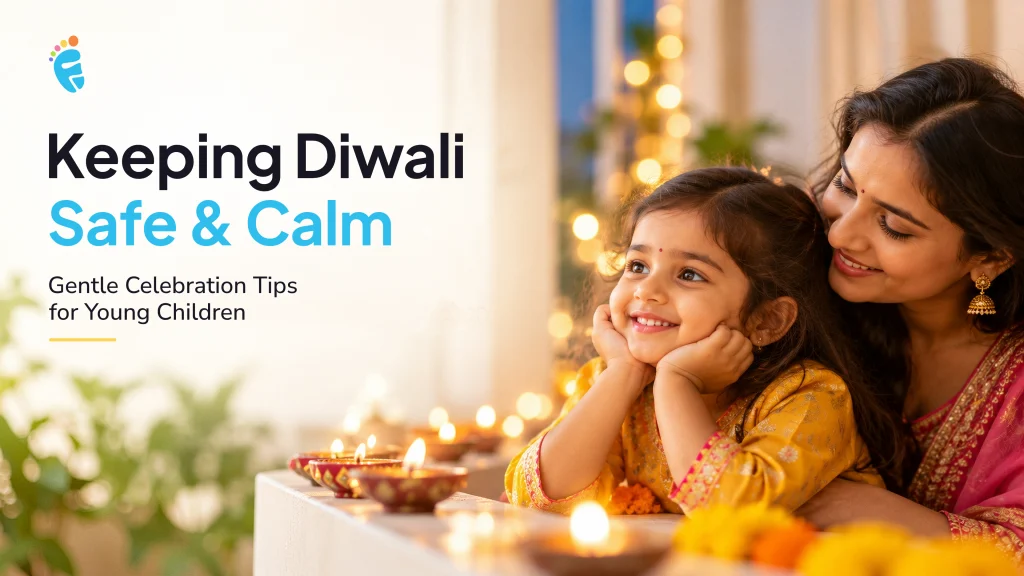
For one, make sure that adults handle all the lighting and that lit diyas are well out of their reach. Comfortable cotton clothes that aren’t flowy are key. HealthyChildren, the parenting site of the American Academy of Pediatrics, advises that young children should never handle fireworks or sparklers and should watch from a safe distance with adult supervision.
The sensory side matters too. Loud crackers can genuinely frighten many children who are sensitive to noise. It is completely fine to watch the Diwali revelry from a balcony using ear protection or even skip crackers entirely. On evenings when fireworks feel too much, you can switch to indoor activities for toddlers as a calmer alternative.
As far as possible, keep the bedtime routine as close to normal as possible. Importantly, expect an overtired child the next day and plan the day’s activities accordingly.
With these small adjustments, Diwali stays safe and gentle for young children.
Simple Diwali Sweets Little Chefs Can Help With
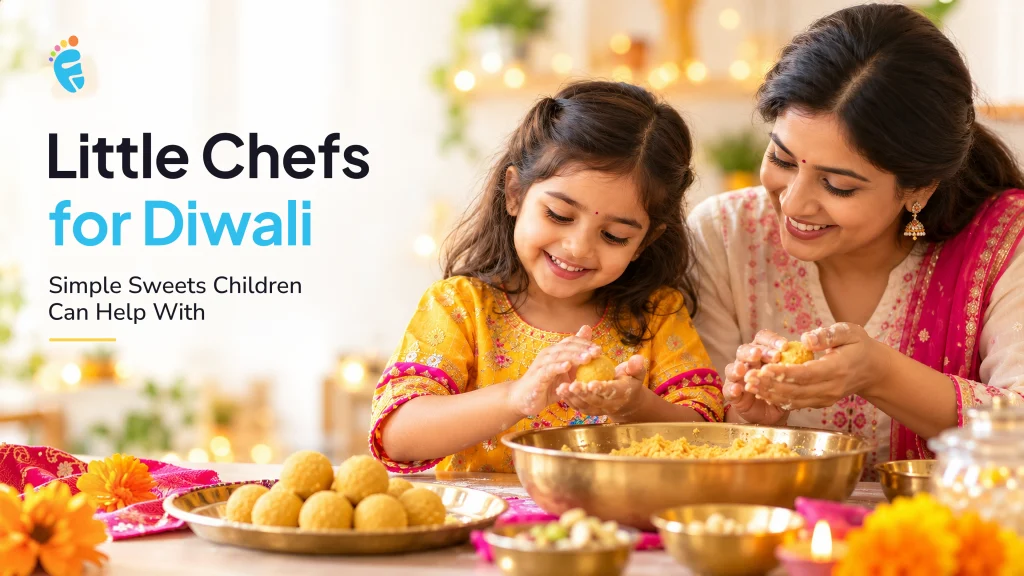
One of the highlights of Diwali is the delicious assortment of sweets prepared and shared among family and friends. Preschoolers can join in as “little chefs” with safe, age‑appropriate tasks such as stirring, rolling, or decorating while adults handle anything near the fire and heat. These hands‑on activities also build motor skills and teach the joy of sharing. Here is a handy recipe for Besan Ladoo, a favourite Diwali sweet.
Besan Ladoo Recipe
| Ingredients |
| – 1 cup besan (gram flour) |
| – 1/4 cup ghee (clarified butter) |
| – 1/2 cup powdered sugar |
| – A pinch of cardamom powder |
| – Chopped nuts (optional) |
Instructions:
- Heat ghee in a pan and add besan. Roast on low heat until golden brown and fragrant.
- Remove from heat, let cool slightly, then add powdered sugar and cardamom powder.
- Mix well and allow to cool further until comfortable to handle.
- Let the child shape it into small ladoos. Roll in chopped nuts if desired.
Watch their faces light up with pride as they create their own Diwali ladoos.
All Activities at a Glance
| Activity | Best Age | Mess Level | What It Builds |
| Single diya drawing | 3–6 yrs | Low | Fine motor, symbolism |
| Row of diyas drawing | 3–6 yrs | Low | Repetition, hand control |
| Rangoli pattern drawing | 4–6 yrs | Medium | Symmetry, creativity |
| Decorated house with lights | 4–6 yrs | Medium | Imagination, cultural connection |
| Lakshmi footprints drawing | 3–5 yrs | Low | Tradition, symbolism |
| Lantern drawing | 4–6 yrs | Medium | Spatial skills, cultural pride |
| Fireworks on dark paper | 3–6 yrs | Medium | Sensory excitement, creativity |
| Flower petal rangoli | 2–5 yrs | Low | Sorting, arranging, sensory play |
| Colored rice/dal rangoli | 3–6 yrs | High | Patience, color recognition |
| Handprint rangoli | 2–4 yrs | High | Sensory play, pattern sense |
| Stencil rangoli | 4–6 yrs | Medium | Independence, neatness |
| Chalk rangoli | 3–6 yrs | Medium | Creativity, easy cleanup |
| Diya painting (poster paint) | 3–6 yrs | Medium | Fine motor, color sense |
| Diya with sequins/paper dots | 3–6 yrs | Medium | Pattern making, creativity |
| Thread‑wrapped diya | 4–6 yrs | Medium | Patience, hand coordination |
| Cotton bud dot diya | 3–5 yrs | Medium | Precision, fine motor |
| Glitter glue diya | 3–6 yrs | Medium | Creativity, festive pride |
| Mirror/bindi sticker diya | 3–6 yrs | Low | Decoration, cultural symbolism |
| Fold‑out diya card | 3–6 yrs | Low | Creativity, early writing |
| Handprint card | 2–4 yrs | High | Sensory play, self‑expression |
| Thumbprint fairy‑light card | 3–6 yrs | Medium | Pattern sense, imagination |
| Own drawing card | 3–6 yrs | Low | Creativity, storytelling |
| Decorated envelope for shagun | 3–6 yrs | Low | Symbolism, generosity |
| Painted photo frame | 4–6 yrs | Medium | Creativity, family bonding |
| Besan ladoo (child helps roll) | 4–6 yrs | Medium | Motor skills, pride in making |
Frequently Asked Questions
1. How do I explain Diwali to a 3-year-old?
Keep it simple. It will be enough to tell them that Diwali is the festival of lights. Long ago, people lit lamps to welcome Rama home after he won against Ravana. We light diyas today to show that good always wins over bad.
2. What is the easiest Diwali craft for a preschooler?
Decorating a clay diya is the simplest. Using poster paint, stickers, or sequins, a 3‑year‑old can make something festive. The joy is in the process, not perfection.
3. How do I make rangoli with a young child without the mess?
Use flower petals or colored paper shapes. Start with a circle, add petals, and dots. These easy rangoli for children avoid powders and keep cleanup simple.
4. Are sparklers safe for a 4-year-old?
No. Young children should not hold sparklers at all. The sparks and heat can cause burns. It is safer to let them watch from a distance while adults handle fireworks.
5. My child is frightened of crackers — what can I do?
Many preschoolers find the noise overwhelming. Watching from a balcony, using ear protection or skipping crackers entirely is fine. Offer a quiet room or switch to indoor play so the festival stays calm and joyful.
6. What can a preschooler draw for Diwali?
Simple shapes work best. Think of a single diya, a row of diyas, a rangoli with circles and petals, fireworks on dark paper, or Lakshmi footprints.
To Sum Up
For preschoolers, a lopsided diya that the child paints themselves matters far more than a perfect decoration. Diwali becomes special when parents and children share these small creative moments, reminding each other that joy lies in effort and togetherness.
UNICEF describes play and creative activity as one of the most powerful ways young children learn about their culture and the world around them
At Footprints Preschool, we encourage preschoolers to actively engage with the spirit of Diwali, just as we do for all other festivals.
Happy Diwali!

Purvesh Sharma is a TED speaker, IIT-Delhi alumnus, certified life coach, and Co-Founder of Footprints Childcare — India’s safest preschool and daycare chain operating multiple centres across 30+ cities. He co-founded Footprints after recognising a fundamental gap: working parents in India needed a childcare option that combined genuine safety, research-backed curriculum, and real-time parent connectivity.
A certified life coach with deep exposure to behavioural science and developmental psychology, Purvesh leads parenting workshops and engagement programmes across Footprints centres — directly engaging with tens of thousands of Indian parents on the challenges of raising young children in urban India. As a parent himself, he brings lived experience to every piece he writes on child behaviour, tantrums, discipline, habit formation, and school readiness.
His writing is grounded in both the science of early childhood development and the real, daily decisions Indian parents face.
 View Fees
 Call Us