

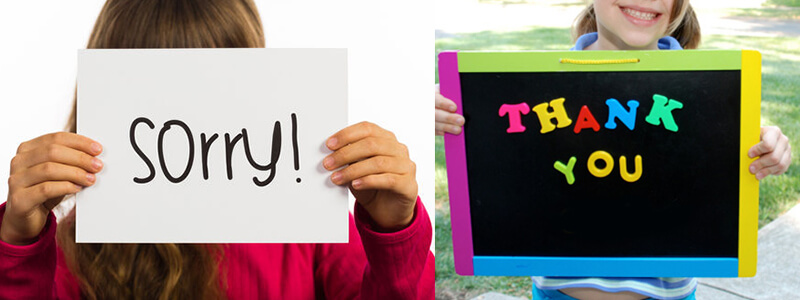
“ Say thank you to auntie”. “ You aren’t getting that toy unless you say please.” If sentences like these sound familiar, it is time to stop in our tracks and take stock. It is a fact that we spend a large portion of our adult life instructing our children what to do and deriving pleasure in them parroting our words. The truth however, is that, children seldom develop true gratitude or empathy or any of these emotions by parroting words they do not genuinely mean.
Modeling the values we desire to instill in our children, however, can go a long way in making them a part and parcel of their lives. Saying please and thank you to the child while making requests or saying a genuine sorry when we have made a mistake, will help the child internalize the lesson for life. Not just this, thanking someone on the child’s behalf can also further drive home the lesson. What we are doing each time, is the following:
Modeling behavior for him that he naturally follows– The observation power of the child coupled with his inherent goodness will ensure that he makes the thank you and please, an integral part of his vocabulary. What is even better is that when he says them, he will genuinely mean them!
Creating trust and connection with the child- Saying sorry or thank you to the child, however, is much more than just modeling good behavior. What it really does is strengthen your relationship with the child. It also helps the child open up about his own feelings and lays the foundation for a lifetime of trust and connection.
However, each time that you say sorry or thank you, ensure that you mean it and that they aren’t just words mouthed casually. A good idea may also be to tell your child what specifically you are sorry about and how bad you are feeling from having acted in a particular manner. Similarly when you see the child expressing genuine apology, it is prudent to give him a sense of closure by saying “ it’s ok” or that you have forgiven him. What it will do for him is to teach him that making amends is not about mouthing a few random words but it is good communication alone that can actually repair a relationship.
Teaching the child good behavior aside, as parents it is imperative for us to not lose sight of the fact that people of all ages need to be treated respectfully. Although we may be the guiding lights for our kids in many ways that does not mean that we can treat them any less respectfully. Sorry, please and thank you are but steps in that direction.
Here is not just to raising a generation of polite children but children who genuinely understand and appreciate the importance of good behavior! Not because they are forced to display it, but because that is the only way of life they know!

Amita Bhardwaj is one of India’s few certified HighScope curriculum trainers, trained and certified by the US-based HighScope Educational Research Foundation — the same framework underpinning over 50,000 preschools across 20+ countries. As Chief Delivery Officer at Footprints Childcare, she has spent the last decade architecting the curriculum and learning outcomes across 230+ centres serving 60,000+ children across India.
With over 30 years in early childhood education, Amita has worked across infant care, toddler development, preschool pedagogy, and educator training. She is also a certified course leader at Landmark Education, the world’s largest personal development organisation, which informs her approach to child-centred learning and growth.
Amita writes on child development milestones, early brain development, age-appropriate activities, infant safety, and curriculum best practices. All parenting content published under the Footprints Childcare blog is reviewed and approved by her before publication.
 View Fees
  Call Us