

Updated: 4-June-2026
The World Health Organization recommends zero screen time for children under 1 year, less than 1 hour of sedentary screen time for children aged 1–3 years, and no more than 1 hour per day for children aged 3–5 years — with higher quality and co-viewing preferred.
Chances are you’ve noticed your 13-month-old reaching for your phone the moment she sees it, or that your 2-year-old has discovered YouTube Shorts and loves watching them.
If your toddler is between 1 and 3 years old, here is what doctors actually recommend. Under 18 months, screens should be off completely while for ages 2 to 3, the recommendation is a maximum of 1 hour a day, co-viewed with a parent.
This post gives you the exact guidelines on screen time and child development by age. Besides, it also offers 6 practical rules that are easy to reinforce at home, screen-free zones that you need to aim for, and handy advice on what to do when a toddler has a meltdown.
What the Research Says — Screen Time by Age for Toddlers (1 to 3 Years)
Parents often seek answers to “how much screen time is healthy”. Let us break this down by age:
Age 12–18 months
- The American Academy of Pediatrics and the World Health Organization recommend zero screen time for children in the age group of 18-24 months, with one key exception – live video calls with family or friends.
- Video calling grandparents or other close family members enable relationship building. It is responsive and language-rich and does not count as solitary screen consumption.
- At this time, the brain is building foundational sensory and motor connections. These are enhanced through real-world human interaction, touch, movement and not through screens.
Age 18–24 months
- Screen time for a two-year-old can span up to 1 hour everyday. The important qualifier here is that it requires a parent to be co-viewing alongside.
- Additionally, the content needs to be slow-paced and language-rich.
- Parents need to play an active role in the viewing process. Pausing the video, naming what you see, asking the child what happens next can act as important coachable moments.
Age 2–3 years
- As the child transitions to age 3, the screen time is recommended at 1 hour per day.
- At this age, children can start to engage more actively with content. As they ask questions and mimic actions, it is important to have a responsive adult answer them.
- Fast-paced videos, auto-play and ad-heavy platforms are best avoided.
- Real play, outdoor time, and peer interaction continue to outperform screens when it comes to enabling child development.
Research from the Harvard Center on the Developing Child highlights that real-world, face-to-face “serve and return” interactions — not screen interactions — are the primary driver of language and social-emotional development in the early years.

Age Table: Complete Screen time guide for parents
| Toddler Age | Daily Limit | Recommended Content | Strict No-Screen Zones |
| 12–18 months | Zero (except video calls) | Video calls with family only | All other times |
| 18–24 months | Up to 1 hour/day | Slow-paced educational content — co-viewed | Bedtime, meals, outdoor play |
| 2–3 years | 1 hour/day maximum | Quality educational content — supervised | First hour of morning, bedtime, meals |
6 Screen Time Rules for Toddlers That Actually Work
The answer to how to limit screen time lies in laying down some practical rules that are also easy to implement. Here are 6 rules that will ensure that screen time does not turn into power play.
Rule 1 – Set the time limit before the screen goes on, not after
- “We watch for 20 minutes, then we read.” Ensure you lay down a reasonable time limit before you hand the device to the child, not when taking it back.
- Use a timer that they can see. A sand timer works far better than a phone alarm to offer them a visual cue.
Rule 2 – No screens in the bedroom, at meals, or first thing in the morning
- Ensure that the bedroom is a no-screen zone as the blue light emitted by phones delays sleep onset in toddlers and also affects daytime behaviour.
- Meal times are a strict no-no as screen distraction at the table tends to suppress hunger cues and also impacts parent-child interaction.
- The first hour of the day sets the tone for the whole day . A screen-free start to the day, therefore, improves focus and mood through the day.
Rule 3 – Watch together whenever possible
- Co-viewing turns passive consumption into an active, language-rich activity
- Remember to ask questions during the video to enable the child to think.
Rule 4 – Have the offline alternative ready before saying no
- “No screen” needs to be followed immediately by offering something engaging. Think sensory bins, sticker books, water play, clay modelling, and more.
- Importantly, the alternative must feel like a win, not a punishment to the child.
Rule 5 – Give transition warnings, not surprise shutdowns
- Ensure that the transition does not feel sudden. “5 more minutes, then we go outside,” offers the child the much-needed transition.
- A 2-minute warning after that softens the transition further
- Use it as a regulation strategy, not a negotiation.
Rule 6 – Model it
- Toddlers copy what they see. If your phone is always in your hand, theirs will be too
- Ensure you spend device-free time with the child. A walk, reading together, and cooking are all interesting alternatives.
The American Academy of Pediatrics recommends that families create a personalised Family Media Use Plan — setting consistent limits on screen time, designating screen-free times (meals, bedtime), and prioritising high-quality, interactive content over passive viewing.
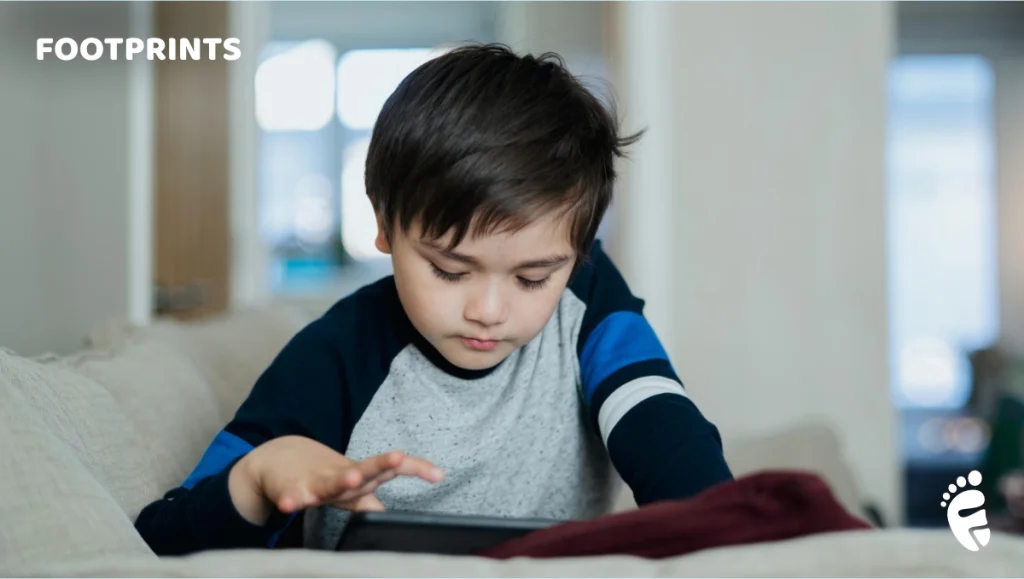
The 4 Times of Day to Keep Screens Away from Toddlers
While you ensure that the child does not have too much screen time, it is especially important to ensure that four times of the day in particular are kept screen-free.
- First hour after waking up: A screen-free morning builds attention and emotional regulation
- 1 hour before bedtime: A calm, screen-free wind-down routine improves sleep quality for toddlers
- Mealtimes: Eating while watching a screen leads to overeating, fussy eating, and reduced family conversation
- Outdoor play time: Unstructured outdoor play is the single highest-value activity for toddler development . Ensure that screen time does not cannibalise this.
What to Do When Your Toddler Won’t Give Up the Phone
Despite your best efforts, there will be times when your toddler will have a meltdown at the prospect of giving up the screen. This is normal and is no reflection on your parenting whatsoever.
What is important to remember is that while it may be tempting to explain the rules during a meltdown, doing so will only reinforce the behaviour. Instead, name the child’s feeling; saying something like “You really wanted to keep watching. That is disappointing.” can validate the child’s feelings and reduce the meltdown duration.
Overall, consistent rules reduce meltdowns over time. Even if the meltdown is very frequent or intense, you need to remind yourself that it signals over-reliance on the screen and not defiance on the part of the child. Gradual and consistent reduction will lead you to results.
While you may be looking for ways to distract the child from the mobile, these are handy tips that you can add to your parenting repertoire.
Frequently Asked Questions
1. Is 1 hour of screen time really OK for a 2-year-old?
Screen time for a two-year-old can span up to 1 hour everyday. However, it requires the parent to be a co-viewer.
2. What happens to a toddler’s brain with too much screen time?
Too much screen time in toddlers can disrupt brain development, leading to attention problems, weaker language skills and reduced social interaction.
3. Can screen time affect my toddler’s speech development?
Yes. Research shows a correlation between screen time and speech delay in children because of reduced interaction with caregivers and slower vocabulary acquisition.
4. Is YouTube Kids safe for children under 2 years old?
For children under 18 months, no screen time is recommended since these years are critical for sensory exploration, bonding, and language acquisition. Passive screen viewing impacts these experiences.
5. How do I know if my toddler is getting too much screen time?
Signs of screen addiction in children show up as signs of excessive screen time include behavioural changes, developmental delays, and sleep disturbances.
6. Are educational apps different from other screen time for toddlers?
Yes. educational apps are different in that they engage toddlers more actively. Some are also designed to offer early literacy and numeracy skills. That said, even educational apps are not a substitute for real-world exploration.
To Sum Up
As a quick overview, children under 18 months of age should be kept screen-free, while those between the ages of 2 and 3 can be offered screens for a maximum of 1 hour, co-viewed with the parent. The six rules listed above, along with four no-screen times, will offer you a handy framework.
That said, while an understanding of age-appropriate limits on screen time for toddlers is important, what is even more important are consistent rules applied calmly and consistently.
At Footprints Play School, we are committed to the holistic development of the child. A child-centric curriculum that incorporates age-appropriate activities ensures the child’s healthy growth and development.

Amita Bhardwaj is one of India’s few certified HighScope curriculum trainers, trained and certified by the US-based HighScope Educational Research Foundation — the same framework underpinning over 50,000 preschools across 20+ countries. As Chief Delivery Officer at Footprints Childcare, she has spent the last decade architecting the curriculum and learning outcomes across 230+ centres serving 60,000+ children across India.
With over 30 years in early childhood education, Amita has worked across infant care, toddler development, preschool pedagogy, and educator training. She is also a certified course leader at Landmark Education, the world’s largest personal development organisation, which informs her approach to child-centred learning and growth.
Amita writes on child development milestones, early brain development, age-appropriate activities, infant safety, and curriculum best practices. All parenting content published under the Footprints Childcare blog is reviewed and approved by her before publication.
 View Fees
  Call Us