

Updated: 5-January-2026
Stories play a powerful role in early childhood learning. Long before formal lessons begin, children understand values, emotions, and behaviour through simple stories shared at home or in school. In fact, storytelling is considered one of the top playgroup activities because it combines listening, imagination, language development, and moral learning in a natural way.
Short moral stories help children distinguish right from wrong, develop empathy, and understand real-life situations through relatable characters. When told regularly, these stories quietly shape a child’s thinking and behaviour without making learning feel forced or instructional.

Benefits of Moral Stories For Children
It’s a well-proven fact that short moral English stories offer several benefits for students. From helping them learn the right social values and deep emotional connections to helping with robust cognitive growth, these little stories have a profound impact on the children. To help you understand this better, here are the main advantages of sharing captivating moral stories with your little ones.
Attention Span: We know how challenging it may be to focus on these youthful, energetic individuals. Short moral stories are a fantastic tool for their level of focus. Using brief moral tales, you can capture and maintain your child’s interest without boring them with a long story.
Language Development: Many play school centers include 10 lines and short stories with morals in their curriculum because it helps in language development. You might not know, but vocabulary skills also get brushed up with the help of short moral stories. Not only that, but these stories also improve a child’s comprehension skills and introduce them to new sentence patterns.
Social & Moral Education: One of the biggest and most important benefits of moral stories is that social issues inspire the stories featured in these books. Reading a moral story can help them learn empathy, sharing, compassion, and other important moral qualities that will make them a good human being or at least what it takes to become one.
Creativity & Imagination: Although young minds are unique and creative, these moral stories let them expand their horizons. Short stories frequently stimulate a child’s imagination because they feature interesting characters, settings, and narratives. Children encourage creativity when they see the situations and characters in their minds.
| Benefit | How It Helps Children |
| Builds strong values | Introduces honesty, kindness, patience, and responsibility |
| Improves listening skills | Encourages focus and attention during storytelling |
| Supports language development | Helps children learn new words and sentence structures |
| Encourages emotional understanding | Teaches empathy and awareness of feelings |
| Develops imagination | Allows children to visualise situations and outcomes |
| Improves social behaviour | Helps children understand right and wrong actions |
| Strengthens memory | Repetition of stories improves recall |
| Promotes positive thinking | Reinforces constructive habits and attitudes |
While there are many more benefits of captivating moral stories for your children, these may be the most important ones. Moral stories are one of the best ways to teach your little one important life lessons and complex concepts most entertainingly.

10 Best Moral Stories for Children
Below are ten timeless moral stories that teach valuable life lessons in a simple and engaging way:
1. The Fox and The Grapes
A hungry fox was walking through a vineyard when he noticed a bunch of ripe grapes hanging high on a vine. His mouth watered. He jumped as high as he could, but the grapes were far above his reach. He tried again and again, changing angles and running faster each time. Still, he could not get them.
Tired and frustrated, the fox finally walked away saying, “Those grapes are probably sour anyway.” But deep down, he knew he was just disappointed.
Moral: It is easy to dislike what we cannot achieve. Effort matters more than excuses.
2. The Golden Egg
A farmer had a goose that laid one golden egg every day. The farmer sold the egg and slowly became comfortable and happy. But as time passed, he began to feel impatient. “If it lays one golden egg daily, it must have many inside,” he thought.
One morning, driven by greed, he cut the goose open. To his shock, there were no golden eggs inside. The farmer lost the goose and the daily golden egg forever.
Moral: Greed can destroy even steady success.
3. The Boy Who Cried Wolf
A shepherd boy felt bored while watching the sheep. To entertain himself, he shouted, “Wolf! Wolf!” Villagers rushed up the hill to help him, but there was no wolf. The boy laughed at their worry.
He repeated the trick again, and again the villagers came running. Later, a real wolf appeared and attacked the flock. The boy cried for help, but the villagers assumed it was another lie. No one came, and the sheep were lost.
Moral: Once trust is broken, it is difficult to rebuild.
4. The Milkmaid & Her Pail
The duties of the milkmaid, Molly, were selling the milk at the market and milking the cows. She began to consider what purchases she would make with her money. She saw a chicken while strolling the market and decided that she could purchase a chicken and sell its eggs to get extra money. She considered how envious she could make the other milkmaid with everything she could get with the money earned from selling milk and eggs. The excitement caused her to skip, and the milk soon overflowed. She had no money and returned home with empty pails. Then, her mother tells her not to count her chickens until they hatch.
Moral: Do not count on outcomes that are not yet certain.
5. The Lion and the Mouse
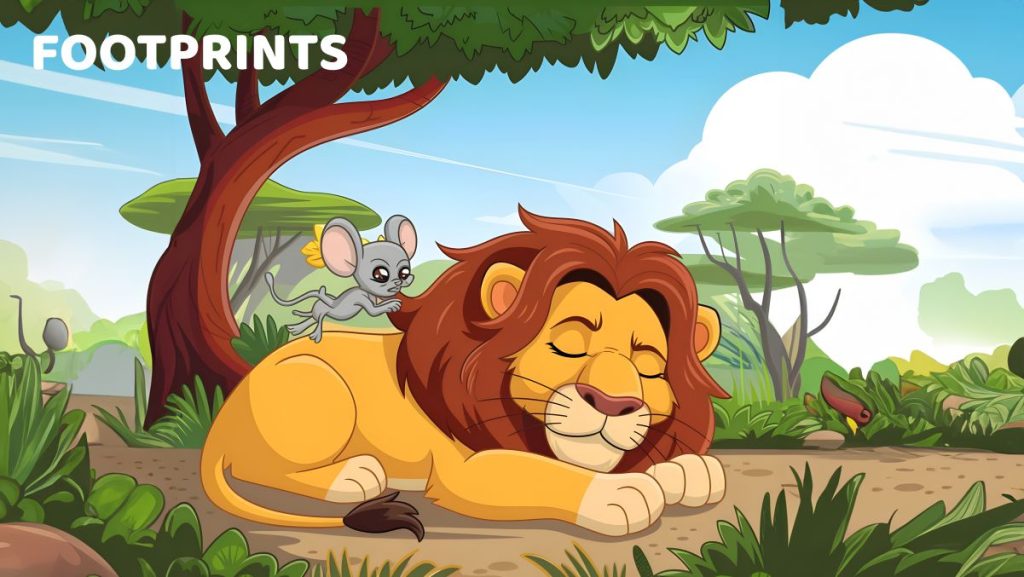
A lion was sleeping in the forest when a little mouse ran over his paw and woke him up. Angry, the lion caught the mouse and was ready to crush it. The mouse pleaded, “Please let me go. One day, I might help you.”
The lion laughed but let the mouse go. Days later, the lion got trapped in a hunter’s net. Hearing his roar, the mouse rushed over and gnawed the ropes until the lion was free. The lion realised that even small friends can be powerful helpers.
Moral: Kindness is never wasted, no matter how small.
6) The Ants and The GrassHopper
All summer long, ants worked together collecting and storing food. Nearby, a grasshopper spent the days singing and enjoying the sunshine. The ants suggested he prepare for winter, but he ignored them.
When winter arrived, the grasshopper had no food and shivered in the cold. He went to the ants and asked for help. The ants reminded him that planning and effort are necessary. The grasshopper realised too late that time wasted cannot be recovered.
Moral: There is a time to work and a time to relax—balance is important.
7) The Honest Woodcutter
A poor woodcutter accidentally dropped his iron axe into a river. He cried because he could not afford another one. A kind spirit appeared and offered him a shiny golden axe. The woodcutter said, “That is not mine.”
The spirit then offered a silver axe. Again, he refused. Finally, the spirit brought the iron axe, and the woodcutter happily accepted it. Impressed by his honesty, the spirit rewarded him with all three axes.
Moral: Honesty is always rewarded.
8) The Thirsty Crow
On a hot day, a thirsty crow searched for water. After flying for a long time, it found a pot with a little water at the bottom. The crow tried to reach it, but its beak could not touch the water.
Instead of giving up, the crow looked around and found small pebbles. It dropped the pebbles into the pot one by one. Slowly, the water level rose. The crow drank the water and flew away happily, proving that calm thinking can solve big problems.
Moral: Intelligence and patience help solve difficult problems.
9) The Bundle of Sticks
A father noticed his children argued constantly. One day, he gave them a single stick and asked them to break it. They broke it easily. Then he tied several sticks into a bundle and asked them to break it again.
No matter how hard they tried, the bundle wouldn’t break. The father explained that just like the sticks, they would be stronger if they stayed united. The children understood that working together makes problems easier to handle.
Moral: Unity makes us strong.
10) The Clever Monkey
A monkey lived near a village and often watched people closely. One day, it noticed a dangerous situation nearby and sensed trouble. Instead of panicking, the monkey quickly observed its surroundings, found a safe path, and escaped at the right moment.
Later, other animals realised that the monkey survived because it stayed alert and used quick thinking. The monkey’s calm behaviour showed that smart decisions often come from observing carefully before acting.
Moral: Presence of mind helps overcome difficult situations.
To Sum Up
Moral stories are one of the simplest yet most effective ways to teach children important life lessons. Through relatable characters and everyday situations, children learn values such as honesty, kindness, patience, and responsibility in a way they can understand and remember. At Footprints Playschool, storytelling is an essential part of early learning. By combining moral stories with play-based and activity-driven methods, we help children develop strong emotional, social, and communication skills that support their lifelong learning.
Frequently Asked Questions (FAQ’s)
1. Why are moral stories important for children?
Moral stories help children understand values through situations they can easily relate to. When children see characters face consequences, they learn what behaviour is helpful or harmful. Stories also build emotional understanding by showing feelings like regret, kindness, jealousy, or gratitude. Over time, repeated storytelling supports better listening skills, stronger vocabulary, and improved social behaviour in everyday interactions.
2. At what age can children start listening to moral stories?
Children can begin enjoying simple moral stories around 2.5–3 years, especially when stories are short and told with expressions, pictures, or actions. At this age, children understand basic emotions and cause-and-effect. As they grow, they begin asking questions about why characters acted a certain way, which deepens learning. The key is choosing age-appropriate stories with clear lessons.
3. How often should moral stories be shared with children?
Sharing stories regularly works best—daily bedtime storytelling or a few times a week is enough. Consistency helps children remember the lessons and recognise patterns in behaviour. When the same value appears across different stories (like honesty or kindness), children understand it more deeply. You can also connect stories to daily life by asking simple questions like, “What would you do?”
4. Can moral stories influence a child’s behaviour?
Yes, especially when adults reinforce the lesson gently. Stories make it easier for children to understand behaviour because they learn through examples rather than direct scolding. If a child hears a story about honesty and then experiences a real situation, they can recall the story’s outcome. Over time, storytelling becomes a soft, positive way to guide behaviour and decision-making.
5. Are moral stories suitable as a playgroup activity?
Absolutely. Storytelling is engaging, calming, and educational, making it ideal for playgroup routines. It supports group listening, turn-taking, and discussion in a simple way. Teachers can add follow-up activities like role play, drawing a scene, or asking children what they learned. That’s why moral storytelling is considered one of the most valuable activities in early learning environments.

Shubham Tiwari is a childcare specialist and education content expert with over 5 years dedicated to India’s early childhood education landscape. His work sits at the intersection of child development research and practical parenting guidance — helping Indian families understand preschool selection, evaluate curriculum quality, recognise developmental milestones, and navigate child safety standards.
Over the course of his career in early childhood education, Shubham has developed deep expertise in the questions Indian parents ask most: when to start preschool, what to look for in a curriculum, how to identify speech delay early, and what genuine early learning looks like versus supervised play. His writing covers preschool admission processes, child safety policies, handwriting and language development, and how early experiences shape long-term brain development.
Shubham’s approach is research-first and parent-first — making early childhood education knowledge accessible to every family, regardless of background.
 View Fees
  Call Us